
Chapter 2 — Sāṅkhya Yoga
From Arjuna’s grief to steady wisdom: the self, responsibility, disciplined action and inner peace.
All 72 verses · 26 teaching films
Begin at verse 1, choose a passage, or read the whole chapter below. Watch in sequence, choose any lesson, or read the chapter below.
Start reading 2.1 · Watch the existing 2.47 pilot · My favourites
Watch Chapter 2
 When sorrow takes over
 A challenge and a call to courage
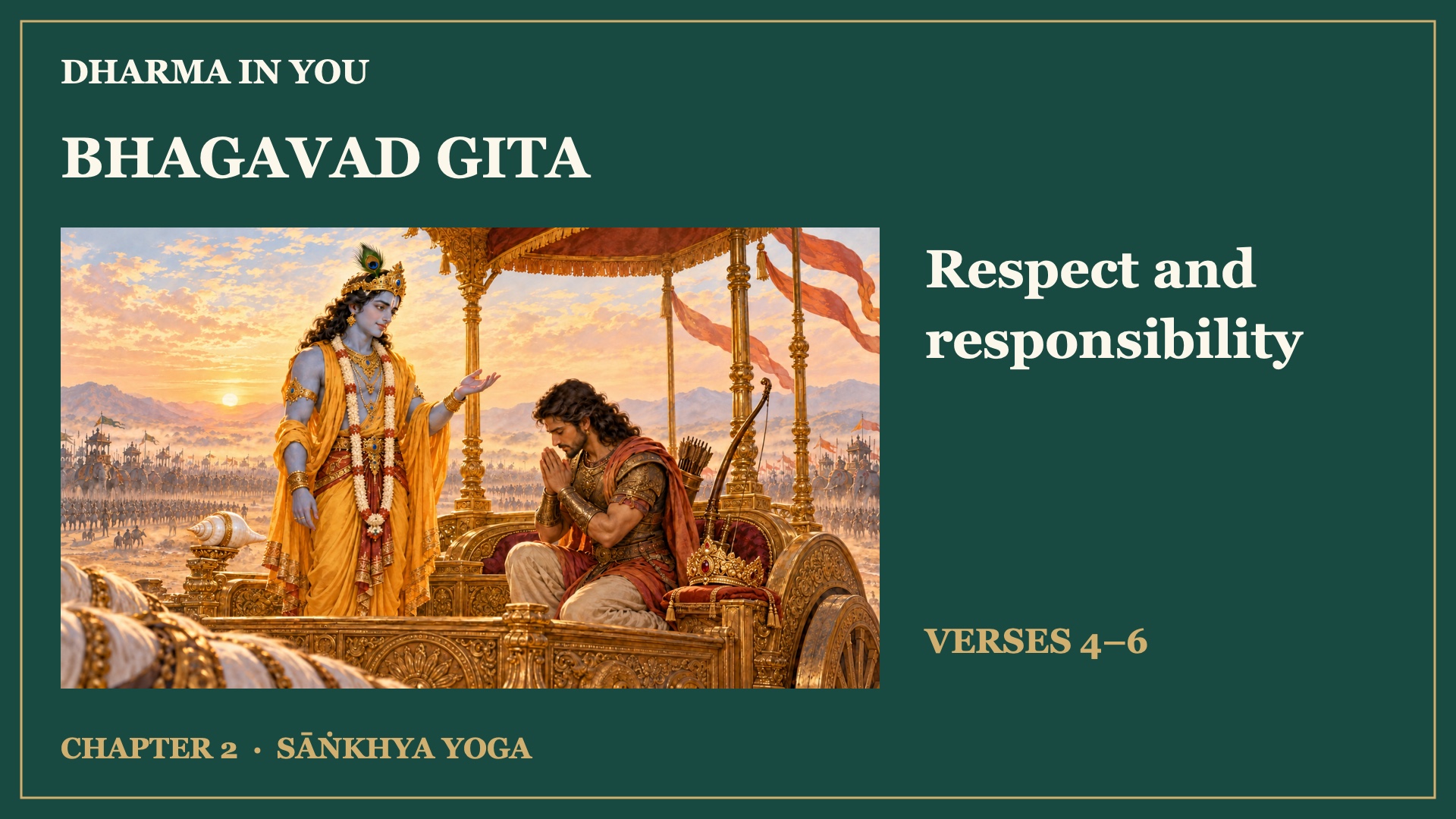 When respect and responsibility collide
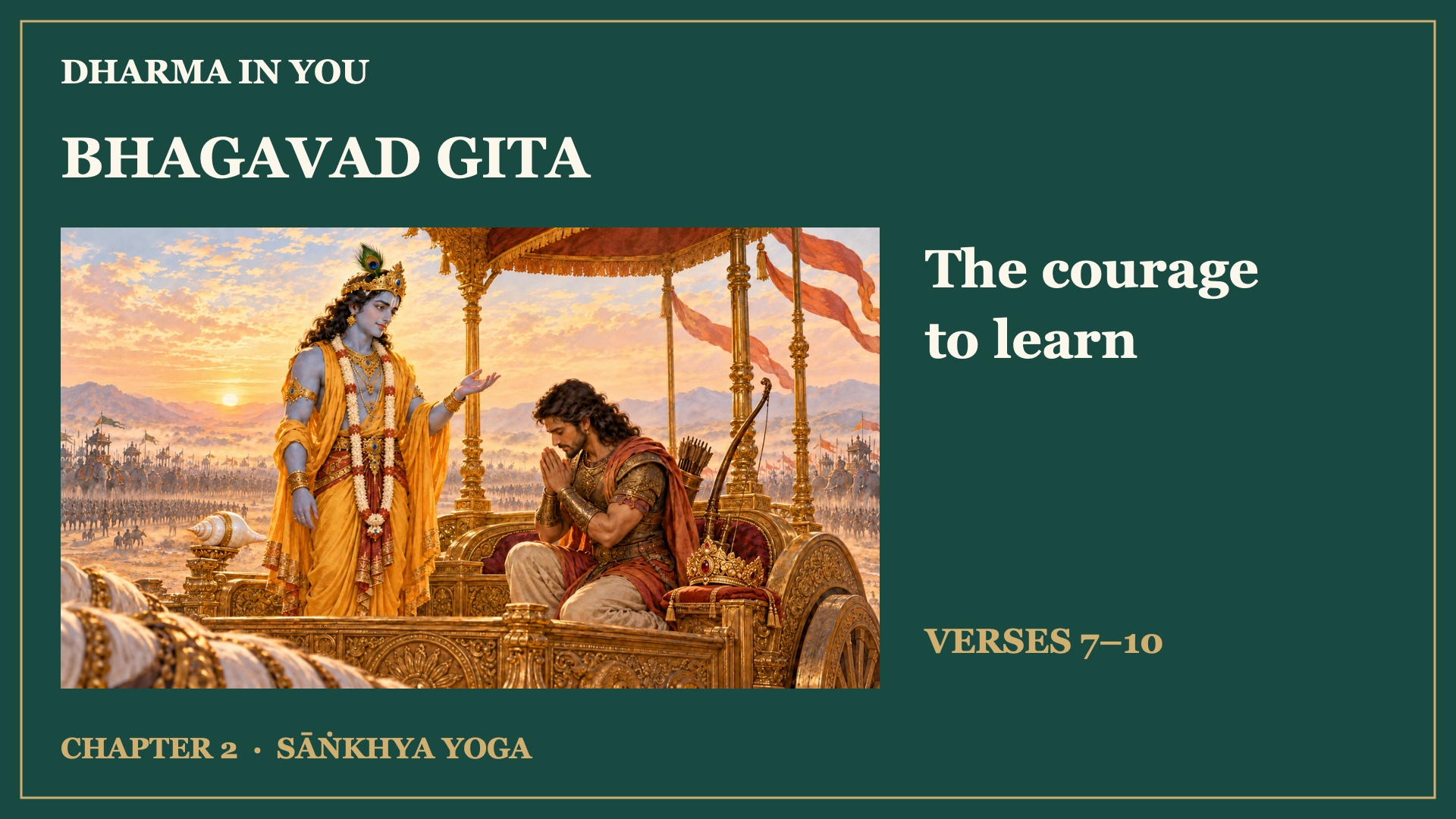 The courage to become a learner
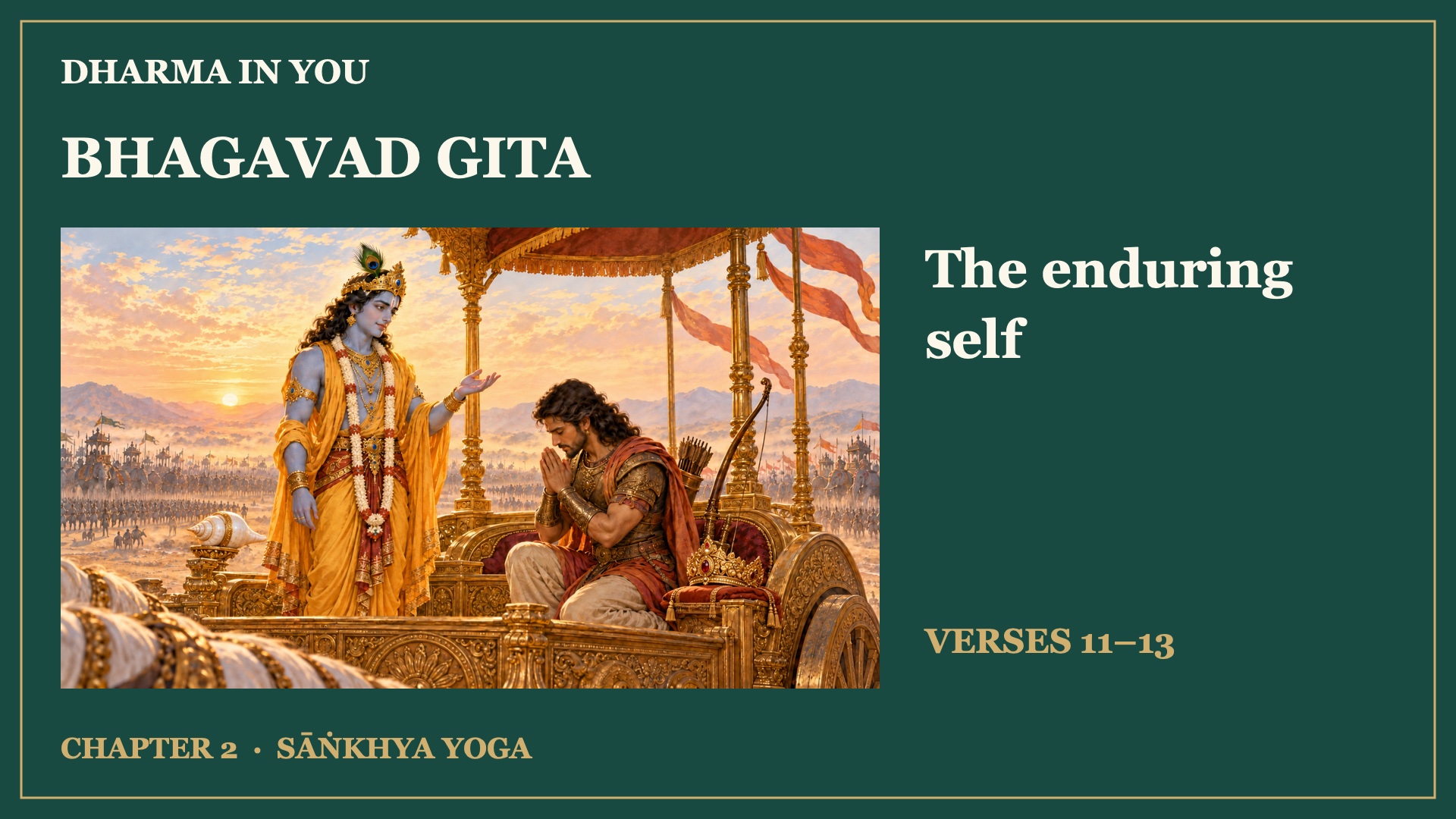 Change and the enduring self
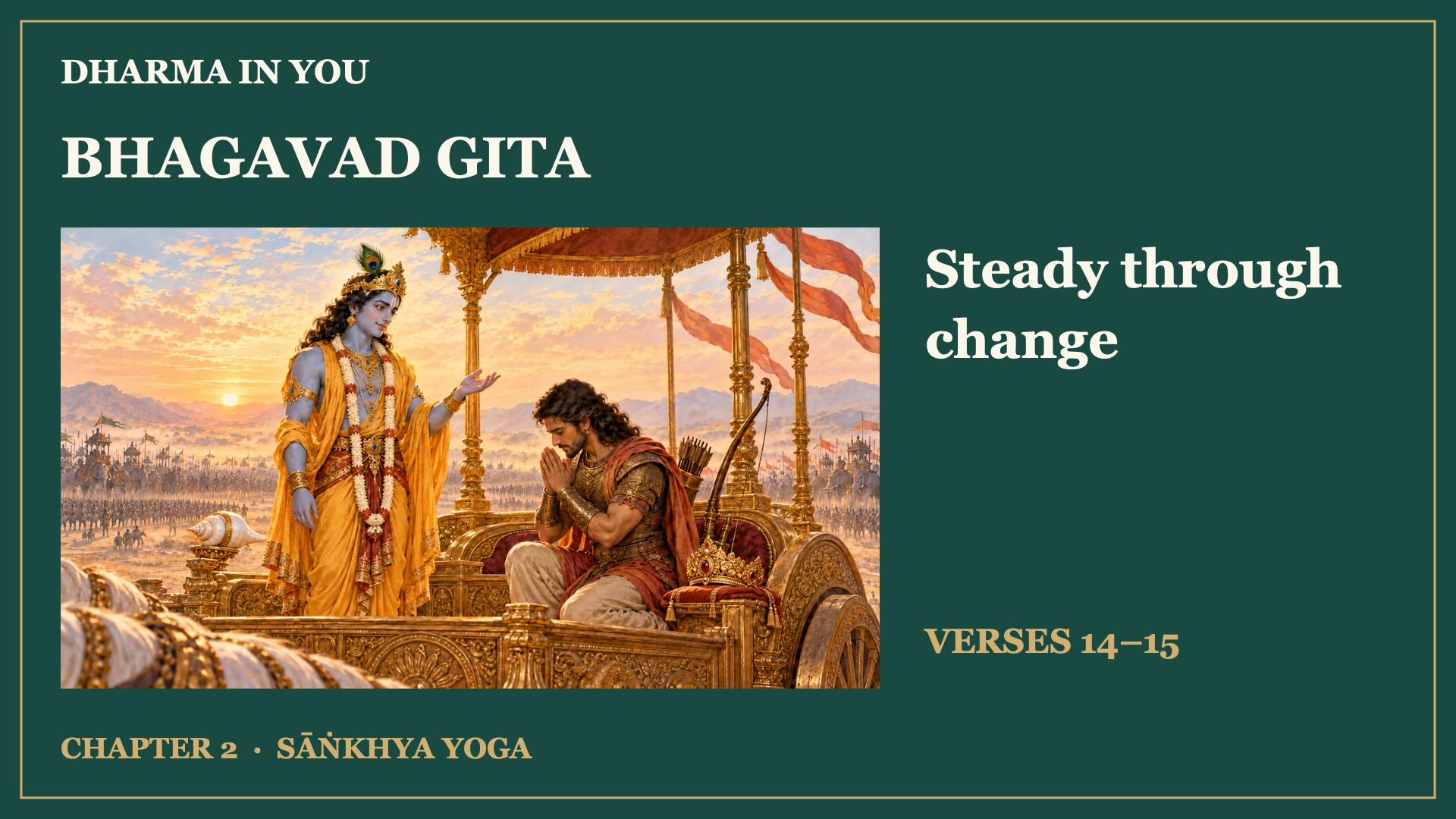 Steadiness through passing experience
 Seeing what changes and what endures
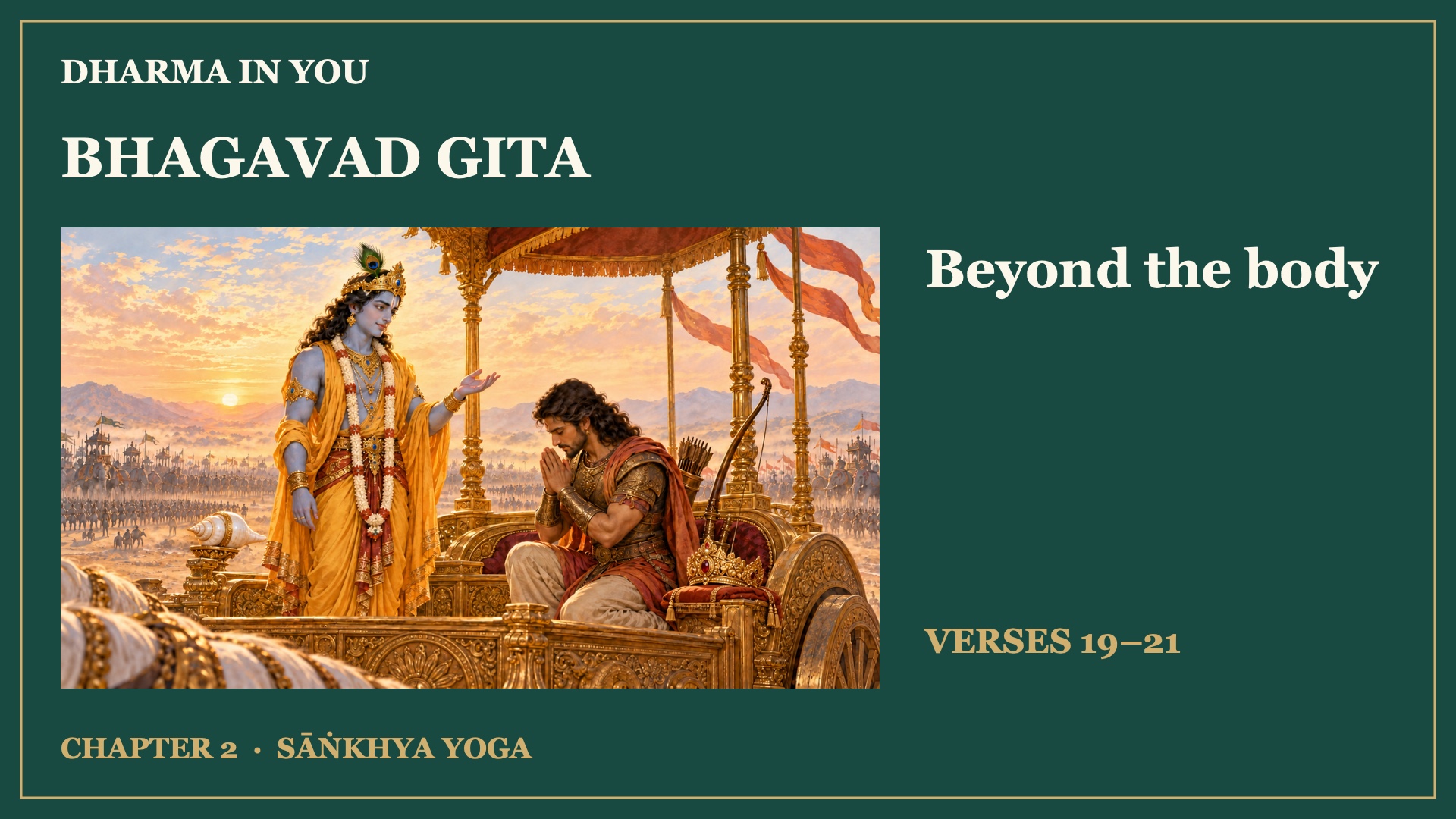 The self is not destroyed with the body
 The garment and the wearer
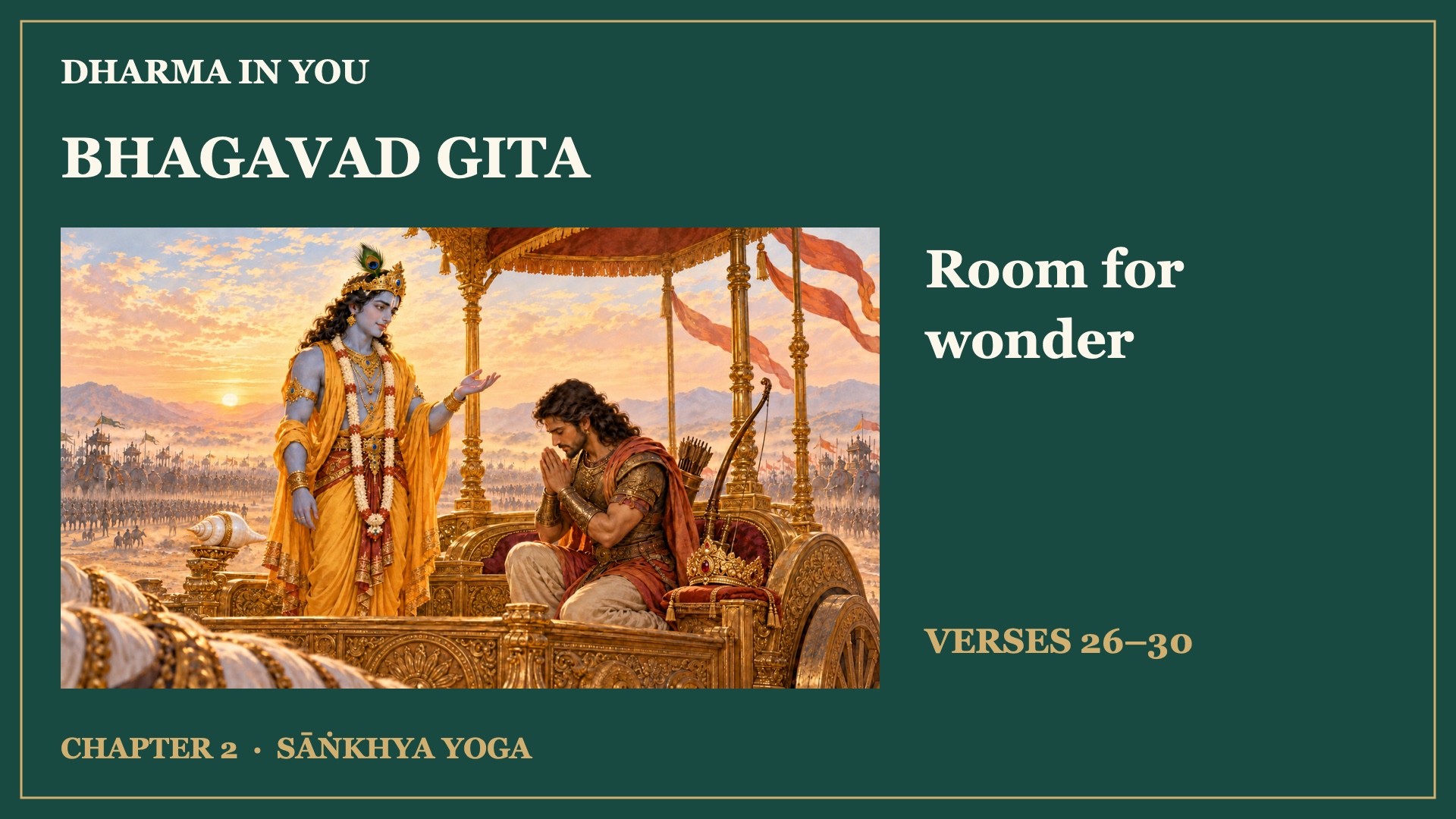 Making room for wonder
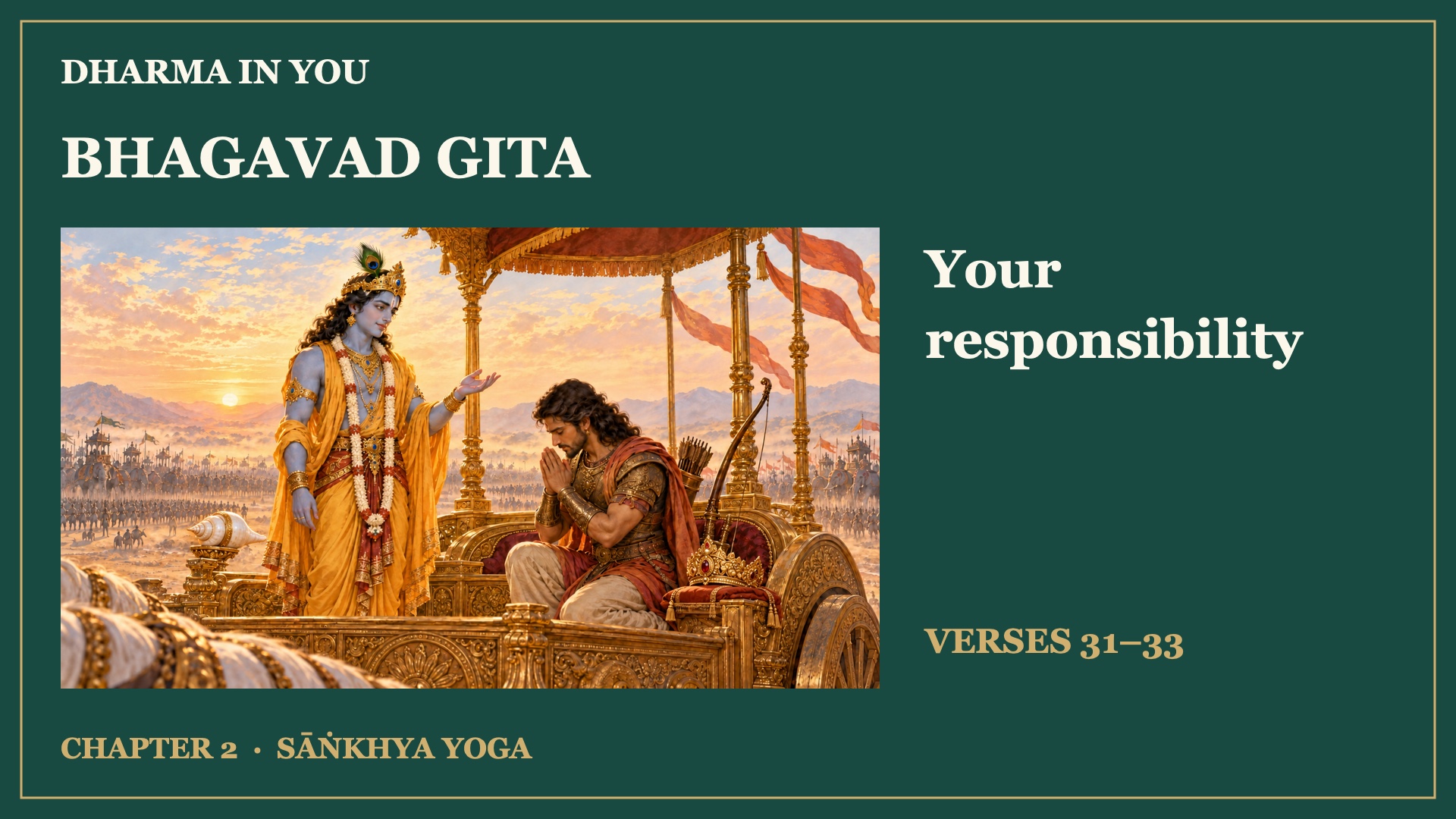 Responsibility in its actual setting
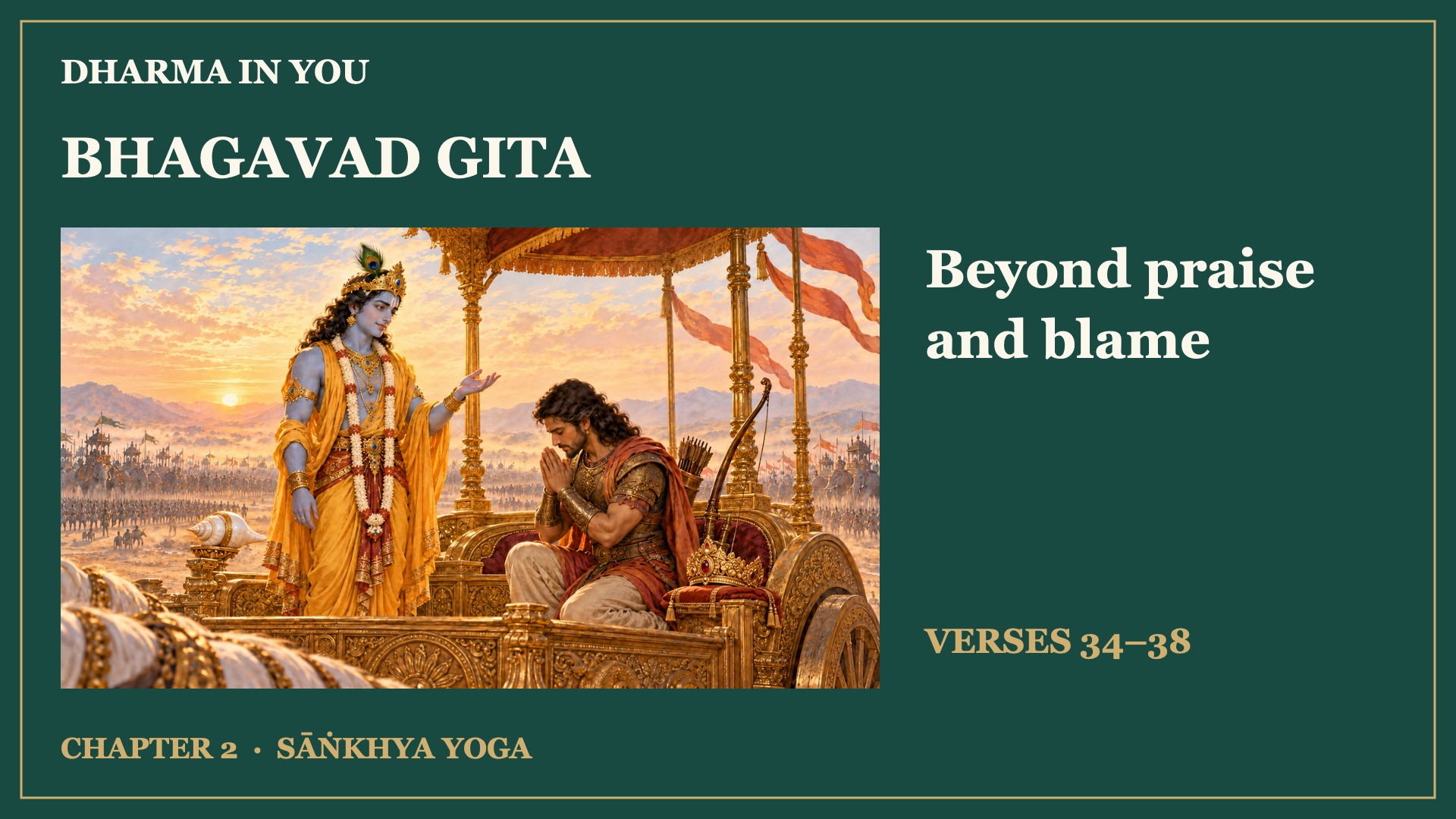 Beyond praise and blame
 A steady direction for practice
 When rewards become the whole purpose
 Seeing beyond acquisition and protection
 Care for the action, release the claim
 Skill guided by understanding
 When the mind stops chasing every answer
 What does steady wisdom look like?
 Restraint and the desire that remains
 Effort, restraint and devotion
 How attention can become a chain
 Moving through the world with clarity
 Give the mind a reliable direction
 The ocean and the arrival of desire
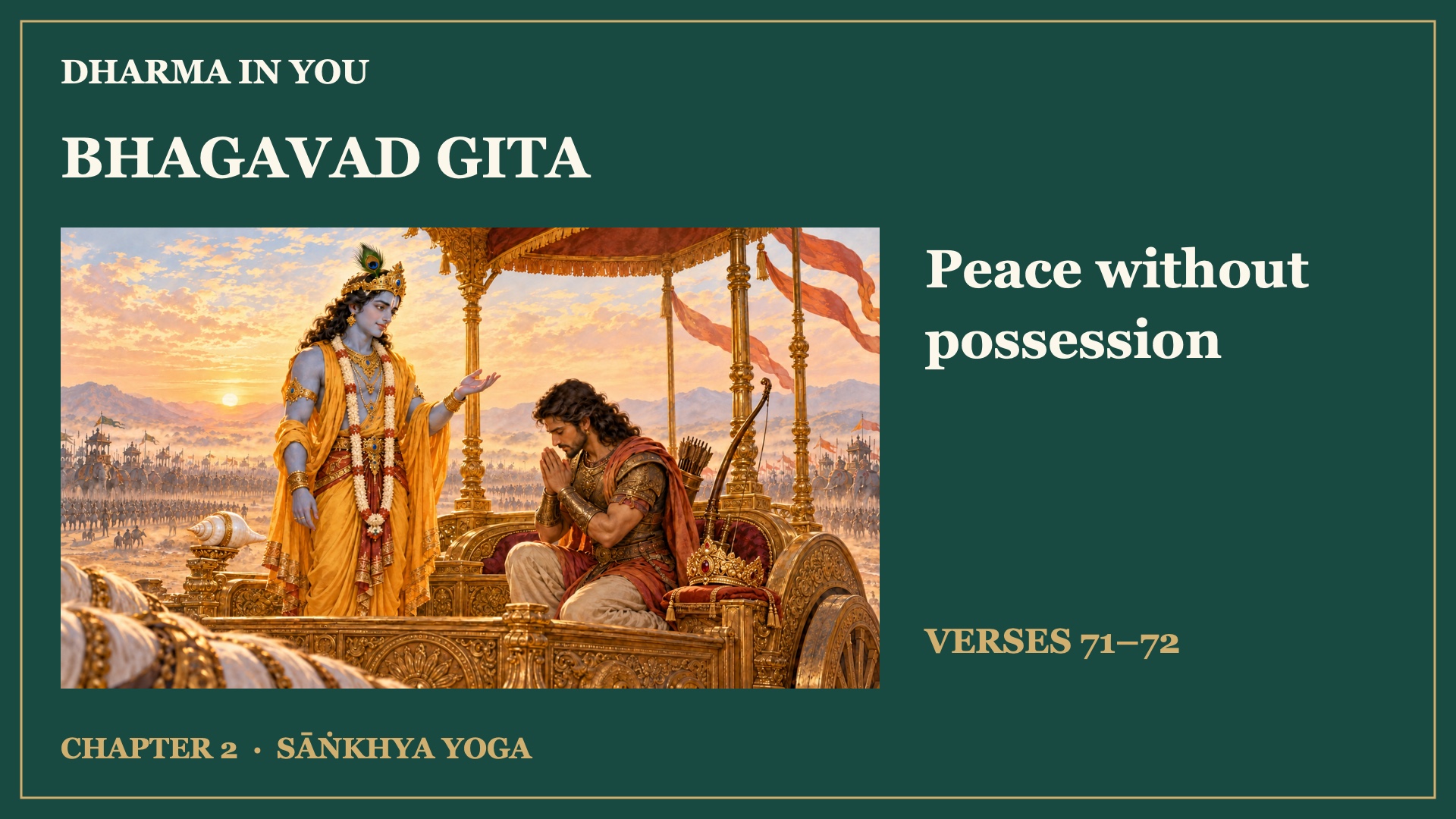 Peace without possessiveness
Follow the chapter
- 2.1 · When sorrow takes over
- 2.2–3 · A challenge and a call to courage
- 2.4–6 · When respect and responsibility collide
- 2.7–10 · The courage to become a learner
- 2.11–13 · Change and the enduring self
- 2.14–15 · Steadiness through passing experience
- 2.16–18 · Seeing what changes and what endures
- 2.19–21 · The self is not destroyed with the body
- 2.22–25 · The garment and the wearer
- 2.26–30 · Making room for wonder
- 2.31–33 · Responsibility in its actual setting
- 2.34–38 · Beyond praise and blame
- 2.39–41 · A steady direction for practice
- 2.42–44 · When rewards become the whole purpose
- 2.45–46 · Seeing beyond acquisition and protection
- 2.47–48 · Care for the action, release the claim
- 2.49–50 · Skill guided by understanding
- 2.51–53 · When the mind stops chasing every answer
- 2.54–56 · What does steady wisdom look like?
- 2.57–59 · Restraint and the desire that remains
- 2.60–61 · Effort, restraint and devotion
- 2.62–63 · How attention can become a chain
- 2.64–65 · Moving through the world with clarity
- 2.66–68 · Give the mind a reliable direction
- 2.69–70 · The ocean and the arrival of desire
- 2.71–72 · Peace without possessiveness
Read in sequence
2.1 · When sorrow takes over
Speaker: Sanjaya, reporting to Dhritarashtra.
The shloka
सञ्जय उवाच
तं तथा कृपयाविष्टमश्रुपूर्णाकुलेक्षणम् ।
विषीदन्तमिदं वाक्यमुवाच मधुसूदनः ॥ १ ॥
Brief meaning
Sanjaya describes Arjuna overwhelmed with sorrow and compassion, his eyes troubled by tears. Krishna, called Madhusudana, begins to address him.
In the conversation
Sanjaya describes Arjuna overwhelmed by grief as Krishna prepares to respond.
Everyday reflection
Before answering a difficult message, pause. Name what happened, what you feel, and the responsibility that remains. A pause can give understanding a chance to guide the reply.
Consider today: Name what feels difficult before looking for an answer.
2.2 · A challenge and a call to courage
Speaker: Krishna, addressing Arjuna.
The shloka
श्री भगवानुवाच
कुतस्त्वा कश्मलमिदं विषमे समुपस्थितम् ।
अनार्यजुष्टमस्वर्ग्यमकीर्तिकरमर्जुन ॥ २ ॥
Brief meaning
Krishna challenges Arjuna’s confusion at a critical moment, describing it as unworthy conduct that brings neither spiritual advancement nor honour.
In the conversation
Krishna challenges Arjuna at the moment of crisis. Read this direct address alongside Arjuna’s questions in the following verses.
Everyday reflection
When a necessary conversation feels difficult, identify one respectful action you can take. Courage can begin with showing up prepared and willing to listen.
Consider today: Notice whether familiar reactions are narrowing your choices.
2.3 · A challenge and a call to courage
Speaker: Krishna, addressing Arjuna.
The shloka
क्लैब्यं मा स्म गमः पार्थ नैतत्त्वय्युपपद्यते ।
क्षुद्रं हृदयदौर्बल्यं त्यक्त्वोत्तिष्ठ परन्तप ॥ ३ ॥
Brief meaning
Krishna urges Arjuna to relinquish this weakness of heart and rise, addressing him by names that recall his strength and lineage.
In the conversation
Krishna challenges Arjuna at the moment of crisis. Read this direct address alongside Arjuna’s questions in the following verses.
Everyday reflection
When a necessary conversation feels difficult, identify one respectful action you can take. Courage can begin with showing up prepared and willing to listen.
Consider today: Choose one small action that requires sincerity and courage.
2.4 · When respect and responsibility collide
Speaker: Arjuna, addressing Krishna.
The shloka
अर्जुन उवाच
कथं भीष्ममहं संख्ये द्रोणं च मधुसूदन ।
इषुभिः प्रतियोत्स्यामि पूजार्हावरिसूदन ॥ ४ ॥
Brief meaning
Arjuna asks how he could aim his arrows at Bhishma and Drona, elders whom he regards as deserving reverence rather than attack.
In the conversation
Arjuna’s objection becomes specific. He names teachers, imagines the cost of winning, and admits that neither outcome feels bearable. The listener should hear a serious moral difficulty, not merely unwillingness to work. His conclusion is still part of the question that Krishna will address.
Everyday reflection
Imagine finding a serious error in work approved by someone who trained you. Gratitude makes you hesitate to challenge it. Yet other people may depend on the information. Begin by separating respect for the person from agreement with the decision. Ask for a private conversation, show the facts and remain open to correction yourself. Respect can shape the way you speak without requiring you to hide what needs attention. What two responsibilities are you trying to hold together?
Consider today: Write the values that appear to be in conflict.
2.5 · When respect and responsibility collide
Speaker: Arjuna, addressing Krishna.
The shloka
गुरूनहत्वा हि महानुभावान्
श्रेयो भोक्तुं भैक्ष्यमपीह लोके ।
हत्वार्थकामांस्तु गुरूनिहैव
भुञ्जीय भोगान्रुधिरप्रदिग्धान् ॥ ५ ॥
Brief meaning
Arjuna says begging would be preferable to killing these respected teachers. He sees any pleasures gained through their deaths as stained by blood.
In the conversation
Arjuna’s objection becomes specific. He names teachers, imagines the cost of winning, and admits that neither outcome feels bearable. The listener should hear a serious moral difficulty, not merely unwillingness to work. His conclusion is still part of the question that Krishna will address.
Everyday reflection
Imagine finding a serious error in work approved by someone who trained you. Gratitude makes you hesitate to challenge it. Yet other people may depend on the information. Begin by separating respect for the person from agreement with the decision. Ask for a private conversation, show the facts and remain open to correction yourself. Respect can shape the way you speak without requiring you to hide what needs attention. What two responsibilities are you trying to hold together?
Consider today: Consider who may be affected by the decision.
2.6 · When respect and responsibility collide
Speaker: Arjuna, addressing Krishna.
The shloka
न चैतद्विद्मः कतरन्नो गरीयो
यद्वा जयेम यदि वा नो जयेयुः ।
यानेव हत्वा न जिजीविषाम-
स्तेऽवस्थिताः प्रमुखे धार्तराष्ट्राः ॥ ६ ॥
Brief meaning
Arjuna cannot decide whether victory or defeat would be better. The people he would struggle to live without are standing against him.
In the conversation
Arjuna’s objection becomes specific. He names teachers, imagines the cost of winning, and admits that neither outcome feels bearable. The listener should hear a serious moral difficulty, not merely unwillingness to work. His conclusion is still part of the question that Krishna will address.
Everyday reflection
Imagine finding a serious error in work approved by someone who trained you. Gratitude makes you hesitate to challenge it. Yet other people may depend on the information. Begin by separating respect for the person from agreement with the decision. Ask for a private conversation, show the facts and remain open to correction yourself. Respect can shape the way you speak without requiring you to hide what needs attention. What two responsibilities are you trying to hold together?
Consider today: Separate facts from assumptions in a difficult choice.
2.7 · The courage to become a learner
Speaker: Arjuna, addressing Krishna.
The shloka
कार्पण्यदोषोपहतस्वभावः
पृच्छामि त्वां धर्मसम्मूढचेताः ।
यच्छ्रेयः स्यान्निश्चितं ब्रूहि तन्मे
शिष्यस्तेऽहं शाधि मां त्वां प्रपन्नम् ॥ ७ ॥
Brief meaning
Admitting confusion about dharma, Arjuna asks Krishna to say what will truly benefit him. He presents himself as a disciple seeking instruction.
In the conversation
The relationship changes when Arjuna asks to be taught. His admission of uncertainty does not instantly settle his resistance: he still says he will not fight. Sanjaya then brings us back to the two armies as Krishna prepares to answer. Guidance begins inside an unfinished human situation.
Everyday reflection
Think of a difficult family decision where you have repeatedly argued for your preferred answer. A different conversation starts when you say what you do not know. Ask a trustworthy person to help examine your assumptions, rather than simply supporting your side. Tell them what matters to you, what you fear and which facts are uncertain. Listening does not mean surrendering your judgement to anyone who sounds confident. It means becoming willing to learn before insisting that the matter is settled.
Consider today: Ask a trusted person one clear question.
2.8 · The courage to become a learner
Speaker: Arjuna, addressing Krishna.
The shloka
न हि प्रपश्यामि ममापनुद्याद् -
यच्छोकमुच्छोषणमिन्द्रियाणाम् ।
अवाप्य भूमावसपत्नमृद्धं
राज्यं सुराणामपि चाधिपत्यम् ॥ ८ ॥
Brief meaning
Arjuna sees no worldly achievement that could remove the grief exhausting him, even an unrivalled kingdom or authority among the gods.
In the conversation
The relationship changes when Arjuna asks to be taught. His admission of uncertainty does not instantly settle his resistance: he still says he will not fight. Sanjaya then brings us back to the two armies as Krishna prepares to answer. Guidance begins inside an unfinished human situation.
Everyday reflection
Think of a difficult family decision where you have repeatedly argued for your preferred answer. A different conversation starts when you say what you do not know. Ask a trustworthy person to help examine your assumptions, rather than simply supporting your side. Tell them what matters to you, what you fear and which facts are uncertain. Listening does not mean surrendering your judgement to anyone who sounds confident. It means becoming willing to learn before insisting that the matter is settled.
Consider today: Identify a concern that achievement alone cannot solve.
2.9 · The courage to become a learner
Speaker: Sanjaya, reporting to Dhritarashtra.
The shloka
सञ्जय उवाच
एवमुक्त्वा हृषीकेशं गुडाकेशः परन्तपः ।
न योत्स्य इति गोविन्दमुक्त्वा तूष्णीं बभूव ह ॥ ९ ॥
Brief meaning
Sanjaya reports that Arjuna tells Krishna he will not fight, and then falls silent. The report distinguishes Arjuna’s statement from the narrator’s voice.
In the conversation
The relationship changes when Arjuna asks to be taught. His admission of uncertainty does not instantly settle his resistance: he still says he will not fight. Sanjaya then brings us back to the two armies as Krishna prepares to answer. Guidance begins inside an unfinished human situation.
Everyday reflection
Think of a difficult family decision where you have repeatedly argued for your preferred answer. A different conversation starts when you say what you do not know. Ask a trustworthy person to help examine your assumptions, rather than simply supporting your side. Tell them what matters to you, what you fear and which facts are uncertain. Listening does not mean surrendering your judgement to anyone who sounds confident. It means becoming willing to learn before insisting that the matter is settled.
Consider today: Make space to listen before defending your position.
2.10 · The courage to become a learner
Speaker: Sanjaya, reporting to Dhritarashtra.
The shloka
तमुवाच हृषीकेशः प्रहसन्निव भारत ।
सेनयोरुभयोर्मध्ये विषीदन्तमिदं वचः ॥ १० ॥
Brief meaning
Sanjaya describes Krishna addressing the sorrowing Arjuna between the two armies, with an expression likened to a smile.
In the conversation
The relationship changes when Arjuna asks to be taught. His admission of uncertainty does not instantly settle his resistance: he still says he will not fight. Sanjaya then brings us back to the two armies as Krishna prepares to answer. Guidance begins inside an unfinished human situation.
Everyday reflection
Think of a difficult family decision where you have repeatedly argued for your preferred answer. A different conversation starts when you say what you do not know. Ask a trustworthy person to help examine your assumptions, rather than simply supporting your side. Tell them what matters to you, what you fear and which facts are uncertain. Listening does not mean surrendering your judgement to anyone who sounds confident. It means becoming willing to learn before insisting that the matter is settled.
Consider today: Offer someone a patient presence.
2.11 · Change and the enduring self
Speaker: Krishna, addressing Arjuna.
The shloka
श्री भगवानुवाच
अशोच्यानन्वशोचस्त्वं प्रज्ञावादांश्च भाषसे ।
गतासूनगतासूंश्च नानुशोचन्ति पण्डिताः ॥ ११ ॥
Brief meaning
Krishna challenges the apparent wisdom of Arjuna’s reasoning and introduces the claim that true understanding changes how one regards life and death.
In the conversation
Krishna begins the sustained teaching with the distinction between changing embodied life and the continuing self. This is a spiritual account of existence, not a claim that the physical body never dies. Different traditions explain the relation of self and ultimate reality in different ways. Keep the verses together before reducing them to a motivational slogan.
Everyday reflection
Look at an old childhood photograph. Your body, abilities and responsibilities have changed. The photograph can invite a question about what you mean when you say “I.” It does not prove the whole doctrine of rebirth. Let it begin reflection rather than end inquiry. You might write down three roles you have occupied and notice that none tells the complete story of who you are. Then return to Krishna’s larger question about the self that is known through those changes.
Consider today: Distinguish your first reaction from your considered understanding.
2.12 · Change and the enduring self
Speaker: Krishna, addressing Arjuna.
The shloka
न त्वेवाहं जातु नासं न त्वं नेमे जनाधिपाः ।
न चैव नभविष्यामः सर्वे वयमतः परम् ॥ १२ ॥
Brief meaning
Krishna speaks of his own existence, Arjuna’s and that of the assembled rulers as extending beyond the present, into both past and future.
In the conversation
Krishna begins the sustained teaching with the distinction between changing embodied life and the continuing self. This is a spiritual account of existence, not a claim that the physical body never dies. Different traditions explain the relation of self and ultimate reality in different ways. Keep the verses together before reducing them to a motivational slogan.
Everyday reflection
Look at an old childhood photograph. Your body, abilities and responsibilities have changed. The photograph can invite a question about what you mean when you say “I.” It does not prove the whole doctrine of rebirth. Let it begin reflection rather than end inquiry. You might write down three roles you have occupied and notice that none tells the complete story of who you are. Then return to Krishna’s larger question about the self that is known through those changes.
Consider today: Keep the question of the self open while reading the source.
2.13 · Change and the enduring self
Speaker: Krishna, addressing Arjuna.
The shloka
देहिनोऽस्मिन्यथा देहे कौमारं यौवनं जरा ।
तथा देहान्तरप्राप्तिर्धीरस्तत्र न मुह्यति ॥ १३ ॥
Brief meaning
Krishna compares the embodied self’s passage into another body with the changes from childhood through maturity to old age within this life.
In the conversation
Krishna begins the sustained teaching with the distinction between changing embodied life and the continuing self. This is a spiritual account of existence, not a claim that the physical body never dies. Different traditions explain the relation of self and ultimate reality in different ways. Keep the verses together before reducing them to a motivational slogan.
Everyday reflection
Look at an old childhood photograph. Your body, abilities and responsibilities have changed. The photograph can invite a question about what you mean when you say “I.” It does not prove the whole doctrine of rebirth. Let it begin reflection rather than end inquiry. You might write down three roles you have occupied and notice that none tells the complete story of who you are. Then return to Krishna’s larger question about the self that is known through those changes.
Consider today: Notice one change in your life without judging your worth.
2.14 · Steadiness through passing experience
Speaker: Krishna, addressing Arjuna.
The shloka
मात्रास्पर्शास्तु कौन्तेय शीतोष्णसुखदुःखदाः ।
आगमापायिनोऽनित्यास्तांस्तितिक्षस्व भारत ॥ १४ ॥
Brief meaning
Contact between senses and their objects produces passing experiences of comfort and discomfort. Krishna asks Arjuna to endure these changes with steadiness.
In the conversation
These verses connect changing sensory experience with the cultivation of endurance. They do not say that pain is imaginary or that a person should remain in an unsafe situation. The teaching asks how the alternation of pleasant and unpleasant experience governs judgement, while keeping liberation as its spiritual horizon.
Everyday reflection
Suppose you receive praise in the morning and criticism in the afternoon. Your work has not become perfect and then worthless within a few hours, yet the mind may swing between those extremes. Pause before making a large decision. Ask what information each response contains and what you can actually improve. A steady response may include gratitude, correction or a clear boundary. Which part of your next action can be guided by understanding rather than the mood of the moment?
Consider today: Pause before reacting to a changing feeling.
2.15 · Steadiness through passing experience
Speaker: Krishna, addressing Arjuna.
The shloka
यं हि न व्यथयन्त्येते पुरुषं पुरुषर्षभ ।
समदुःखसुखं धीरं सोऽमृतत्वाय कल्पते ॥ १५ ॥
Brief meaning
One who remains steady through pleasure and pain, without being overpowered by their alternation, is described as fit for immortality or liberation.
In the conversation
These verses connect changing sensory experience with the cultivation of endurance. They do not say that pain is imaginary or that a person should remain in an unsafe situation. The teaching asks how the alternation of pleasant and unpleasant experience governs judgement, while keeping liberation as its spiritual horizon.
Everyday reflection
Suppose you receive praise in the morning and criticism in the afternoon. Your work has not become perfect and then worthless within a few hours, yet the mind may swing between those extremes. Pause before making a large decision. Ask what information each response contains and what you can actually improve. A steady response may include gratitude, correction or a clear boundary. Which part of your next action can be guided by understanding rather than the mood of the moment?
Consider today: Keep one helpful commitment through an ordinary inconvenience.
2.16 · Seeing what changes and what endures
Speaker: Krishna, addressing Arjuna.
The shloka
नासतो विद्यते भावो नाभावो विद्यते सतः ।
उभयोरपि दृष्टोऽन्तस्त्वनयोस्तत्त्वदर्शिभिः ॥ १६ ॥
Brief meaning
Krishna distinguishes what lacks enduring reality from what does not cease to be, referring to the discernment of those who see truth.
In the conversation
The chapter deepens its distinction between bodily change and the imperishable self. Krishna also connects that claim with Arjuna’s battlefield duty. We must retain both parts of the passage, without turning a metaphysical account into an excuse to dismiss the consequences of harming bodies. The practical reflection is an analogy, not the whole teaching.
Everyday reflection
Imagine that a project ends and the title you held disappears. The loss may affect money, identity and daily rhythm. Begin by acknowledging those real effects. Then ask which commitments can continue through the change: honesty, care, patience or a willingness to learn. A role can change without exhausting every dimension of your life. This small inquiry does not establish the eternal self by itself, but it can help distinguish a temporary description from the whole of a person.
Consider today: Distinguish a passing situation from what you deeply value.
2.17 · Seeing what changes and what endures
Speaker: Krishna, addressing Arjuna.
The shloka
अविनाशि तु तद्विद्धि येन सर्वमिदं ततम् ।
विनाशमव्ययस्यास्य न कश्चित्कर्तुमर्हति ॥ १७ ॥
Brief meaning
That which pervades the body is described as imperishable. Krishna says no one can bring destruction to this enduring reality.
In the conversation
The chapter deepens its distinction between bodily change and the imperishable self. Krishna also connects that claim with Arjuna’s battlefield duty. We must retain both parts of the passage, without turning a metaphysical account into an excuse to dismiss the consequences of harming bodies. The practical reflection is an analogy, not the whole teaching.
Everyday reflection
Imagine that a project ends and the title you held disappears. The loss may affect money, identity and daily rhythm. Begin by acknowledging those real effects. Then ask which commitments can continue through the change: honesty, care, patience or a willingness to learn. A role can change without exhausting every dimension of your life. This small inquiry does not establish the eternal self by itself, but it can help distinguish a temporary description from the whole of a person.
Consider today: Reflect on the Gita’s account of the self; do not turn it into a scientific claim.
2.18 · Seeing what changes and what endures
Speaker: Krishna, addressing Arjuna.
The shloka
अन्तवन्त इमे देहा नित्यस्योक्ताः शरीरिणः ।
अनाशिनोऽप्रमेयस्य तस्माद्युध्यस्व भारत ॥ १८ ॥
Brief meaning
Bodies are said to have an end, while the embodied self is enduring and beyond measurement. Krishna connects this teaching to Arjuna’s duty to fight.
In the conversation
The chapter deepens its distinction between bodily change and the imperishable self. Krishna also connects that claim with Arjuna’s battlefield duty. We must retain both parts of the passage, without turning a metaphysical account into an excuse to dismiss the consequences of harming bodies. The practical reflection is an analogy, not the whole teaching.
Everyday reflection
Imagine that a project ends and the title you held disappears. The loss may affect money, identity and daily rhythm. Begin by acknowledging those real effects. Then ask which commitments can continue through the change: honesty, care, patience or a willingness to learn. A role can change without exhausting every dimension of your life. This small inquiry does not establish the eternal self by itself, but it can help distinguish a temporary description from the whole of a person.
Consider today: Hold care for embodied life alongside the text’s spiritual teaching.
2.19 · The self is not destroyed with the body
Speaker: Krishna, addressing Arjuna.
The shloka
य एनं वेत्ति हन्तारं यश्चैनं मन्यते हतम् ।
उभौ तौ न विजानीतो नायं हन्ति न हन्यते ॥ १९ ॥
Brief meaning
The self is not adequately understood either as a killer or as something killed. The verse distinguishes the self from bodily acts and destruction.
In the conversation
Krishna uses strong language about the self’s relation to birth, death and killing. The passage concerns the self’s nature within his teaching to Arjuna; it is not a general permission to injure others. An attentive explanation keeps spiritual ontology, embodied suffering and moral responsibility distinct rather than collapsing them into one sentence.
Everyday reflection
When someone experiences a serious loss, do not rush to offer a doctrine as if it should remove their sorrow immediately. You can listen, help with a practical task and allow their own beliefs to guide the conversation. A teaching about the self may become a source of contemplation over time. It need not become a demand that another person stop feeling. How could your understanding of a person’s dignity make your next act of care more patient and concrete?
Consider today: Read with the battlefield context and the ethical question intact.
2.20 · The self is not destroyed with the body
Speaker: Krishna, addressing Arjuna.
The shloka
न जायते म्रियते वा कदाचि-
न्नायं भूत्वा भविता वा न भूयः ।
अजो नित्यः शाश्वतोऽयं पुराणो
न हन्यते हन्यमाने शरीरे ॥ २० ॥
Brief meaning
Krishna describes the self as unborn, enduring and unchanging, rather than something newly produced or destroyed when a body dies.
In the conversation
Krishna uses strong language about the self’s relation to birth, death and killing. The passage concerns the self’s nature within his teaching to Arjuna; it is not a general permission to injure others. An attentive explanation keeps spiritual ontology, embodied suffering and moral responsibility distinct rather than collapsing them into one sentence.
Everyday reflection
When someone experiences a serious loss, do not rush to offer a doctrine as if it should remove their sorrow immediately. You can listen, help with a practical task and allow their own beliefs to guide the conversation. A teaching about the self may become a source of contemplation over time. It need not become a demand that another person stop feeling. How could your understanding of a person’s dignity make your next act of care more patient and concrete?
Consider today: Notice what this spiritual claim invites you to ask.
2.21 · The self is not destroyed with the body
Speaker: Krishna, addressing Arjuna.
The shloka
वेदाविनाशिनं नित्यं य एनमजमव्ययम् ।
कथं स पुरुषः पार्थ कं घातयति हन्ति कम् ॥ २१ ॥
Brief meaning
Krishna asks how a person who knows the self as unborn and imperishable could regard it as killing or causing another to be killed.
In the conversation
Krishna uses strong language about the self’s relation to birth, death and killing. The passage concerns the self’s nature within his teaching to Arjuna; it is not a general permission to injure others. An attentive explanation keeps spiritual ontology, embodied suffering and moral responsibility distinct rather than collapsing them into one sentence.
Everyday reflection
When someone experiences a serious loss, do not rush to offer a doctrine as if it should remove their sorrow immediately. You can listen, help with a practical task and allow their own beliefs to guide the conversation. A teaching about the self may become a source of contemplation over time. It need not become a demand that another person stop feeling. How could your understanding of a person’s dignity make your next act of care more patient and concrete?
Consider today: Ask how understanding could change conduct.
2.22 · The garment and the wearer
Speaker: Krishna, addressing Arjuna.
The shloka
वासांसि जीर्णानि यथा विहाय
नवानि गृह्णाति नरोऽपराणि ।
तथा शरीराणि विहाय जीर्णा-
न्यन्यानि संयाति नवानि देही ॥ २२ ॥
Brief meaning
The self’s change of bodies is compared to a person setting aside worn clothing and putting on other garments.
In the conversation
The clothing image makes an abstract teaching approachable, then Krishna describes the self through what cannot damage it. A metaphor opens understanding without making bodies disposable. Remember that the conversation concerns Arjuna’s confusion about death and duty, and that a physical illustration can point toward a claim it cannot fully depict.
Everyday reflection
Consider a favourite coat that has become too worn to use. Replacing it does not replace the person who wore it. That everyday observation helps explain the form of the metaphor, but changing a coat is not identical to death or bereavement. Keep that difference clear. The reflection is an invitation to ask whether we identify ourselves entirely with what changes. When a possession, appearance or role alters, can you respond with care without assuming your entire worth has disappeared?
Consider today: Identify one role you occupy without equating it with your whole identity.
2.23 · The garment and the wearer
Speaker: Krishna, addressing Arjuna.
The shloka
नैनं छिन्दन्ति शस्त्राणि नैनं दहति पावकः ।
न चैनं क्लेदयन्त्यापो न शोषयति मारुतः ॥ २३ ॥
Brief meaning
The self is described as beyond the destructive reach of weapons, fire, water and wind, unlike material things affected by these forces.
In the conversation
The clothing image makes an abstract teaching approachable, then Krishna describes the self through what cannot damage it. A metaphor opens understanding without making bodies disposable. Remember that the conversation concerns Arjuna’s confusion about death and duty, and that a physical illustration can point toward a claim it cannot fully depict.
Everyday reflection
Consider a favourite coat that has become too worn to use. Replacing it does not replace the person who wore it. That everyday observation helps explain the form of the metaphor, but changing a coat is not identical to death or bereavement. Keep that difference clear. The reflection is an invitation to ask whether we identify ourselves entirely with what changes. When a possession, appearance or role alters, can you respond with care without assuming your entire worth has disappeared?
Consider today: Read the imagery carefully before drawing an everyday analogy.
2.24 · The garment and the wearer
Speaker: Krishna, addressing Arjuna.
The shloka
अच्छेद्योऽयमदाह्योऽयमक्लेद्योऽशोष्य एव च ।
नित्यः सर्वगतः स्थाणुरचलोऽयं सनातनः ॥ २४ ॥
Brief meaning
Krishna continues describing the self as uncuttable, unburnable, undryable and unwettable: enduring, stable and not subject to ordinary material change.
In the conversation
The clothing image makes an abstract teaching approachable, then Krishna describes the self through what cannot damage it. A metaphor opens understanding without making bodies disposable. Remember that the conversation concerns Arjuna’s confusion about death and duty, and that a physical illustration can point toward a claim it cannot fully depict.
Everyday reflection
Consider a favourite coat that has become too worn to use. Replacing it does not replace the person who wore it. That everyday observation helps explain the form of the metaphor, but changing a coat is not identical to death or bereavement. Keep that difference clear. The reflection is an invitation to ask whether we identify ourselves entirely with what changes. When a possession, appearance or role alters, can you respond with care without assuming your entire worth has disappeared?
Consider today: Choose one value to keep present during change.
2.25 · The garment and the wearer
Speaker: Krishna, addressing Arjuna.
The shloka
अव्यक्तोऽयमचिन्त्योऽयमविकार्योऽयमुच्यते ।
तस्मादेवं विदित्वैनं नानुशोचितुमर्हसि ॥ २५ ॥
Brief meaning
The self is described as unmanifest, beyond ordinary thought and unchanging. Krishna presents this understanding as a reason to reconsider grief.
In the conversation
The clothing image makes an abstract teaching approachable, then Krishna describes the self through what cannot damage it. A metaphor opens understanding without making bodies disposable. Remember that the conversation concerns Arjuna’s confusion about death and duty, and that a physical illustration can point toward a claim it cannot fully depict.
Everyday reflection
Consider a favourite coat that has become too worn to use. Replacing it does not replace the person who wore it. That everyday observation helps explain the form of the metaphor, but changing a coat is not identical to death or bereavement. Keep that difference clear. The reflection is an invitation to ask whether we identify ourselves entirely with what changes. When a possession, appearance or role alters, can you respond with care without assuming your entire worth has disappeared?
Consider today: Allow a question to remain unresolved.
2.26 · Making room for wonder
Speaker: Krishna, addressing Arjuna.
The shloka
अथ चैनं नित्यजातं नित्यं वा मन्यसे मृतम् ।
तथापि त्वं महाबाहो नैनं शोचितुमर्हसि ॥ २६ ॥
Brief meaning
Krishna offers a further argument: even if Arjuna thought of the self as repeatedly born and dying, the inevitability of change would remain.
In the conversation
Krishna considers another way of thinking about repeated birth and death, then returns to the enduring self. The movement includes inevitability, appearance and disappearance, and wonder. Hearing a description is not the same as realising its meaning. A thoughtful lesson can leave room for questions instead of promising instant certainty.
Everyday reflection
You may encounter a teaching that you cannot yet accept or reject confidently. Instead of pretending certainty, write the claim in your own words and note the question it raises. Ask how the tradition explains it and what remains unclear. Wonder becomes useful when it leads to attentive inquiry, rather than collecting impressive phrases. In a conversation today, try saying: “I would like to understand that more carefully.” Honest uncertainty can be a more fruitful beginning than a borrowed conclusion.
Consider today: Notice how a different premise changes an argument.
2.27 · Making room for wonder
Speaker: Krishna, addressing Arjuna.
The shloka
जातस्य हि ध्रुवो मृत्युर्ध्रुवं जन्म मृतस्य च ।
तस्मादपरिहार्येऽर्थे न त्वं शोचितुमर्हसि ॥ २७ ॥
Brief meaning
For what is born, death is certain; for what dies, birth follows in this teaching. Krishna asks Arjuna to consider what cannot be avoided.
In the conversation
Krishna considers another way of thinking about repeated birth and death, then returns to the enduring self. The movement includes inevitability, appearance and disappearance, and wonder. Hearing a description is not the same as realising its meaning. A thoughtful lesson can leave room for questions instead of promising instant certainty.
Everyday reflection
You may encounter a teaching that you cannot yet accept or reject confidently. Instead of pretending certainty, write the claim in your own words and note the question it raises. Ask how the tradition explains it and what remains unclear. Wonder becomes useful when it leads to attentive inquiry, rather than collecting impressive phrases. In a conversation today, try saying: “I would like to understand that more carefully.” Honest uncertainty can be a more fruitful beginning than a borrowed conclusion.
Consider today: Offer practical care to someone facing a transition.
2.28 · Making room for wonder
Speaker: Krishna, addressing Arjuna.
The shloka
अव्यक्तादीनि भूतानि व्यक्तमध्यानि भारत ।
अव्यक्तनिधनान्येव तत्र का परिदेवना ॥ २८ ॥
Brief meaning
Beings are unmanifest before their appearance and after their disappearance, and manifest in between. Krishna asks what follows from seeing this pattern.
In the conversation
Krishna considers another way of thinking about repeated birth and death, then returns to the enduring self. The movement includes inevitability, appearance and disappearance, and wonder. Hearing a description is not the same as realising its meaning. A thoughtful lesson can leave room for questions instead of promising instant certainty.
Everyday reflection
You may encounter a teaching that you cannot yet accept or reject confidently. Instead of pretending certainty, write the claim in your own words and note the question it raises. Ask how the tradition explains it and what remains unclear. Wonder becomes useful when it leads to attentive inquiry, rather than collecting impressive phrases. In a conversation today, try saying: “I would like to understand that more carefully.” Honest uncertainty can be a more fruitful beginning than a borrowed conclusion.
Consider today: Reflect quietly on the limits of what you can see.
2.29 · Making room for wonder
Speaker: Krishna, addressing Arjuna.
The shloka
आश्चर्यवत्पश्यति कश्चिदेन -
माश्चर्यवद्वदति तथैव चान्यः ।
आश्चर्यवच्चैनमन्यः शृणोति
श्रुत्वाप्येनं वेद न चैव कश्चित् ॥ २९ ॥
Brief meaning
The self is spoken of as a wonder: seen, described and heard about with amazement, yet not necessarily understood merely by hearing.
In the conversation
Krishna considers another way of thinking about repeated birth and death, then returns to the enduring self. The movement includes inevitability, appearance and disappearance, and wonder. Hearing a description is not the same as realising its meaning. A thoughtful lesson can leave room for questions instead of promising instant certainty.
Everyday reflection
You may encounter a teaching that you cannot yet accept or reject confidently. Instead of pretending certainty, write the claim in your own words and note the question it raises. Ask how the tradition explains it and what remains unclear. Wonder becomes useful when it leads to attentive inquiry, rather than collecting impressive phrases. In a conversation today, try saying: “I would like to understand that more carefully.” Honest uncertainty can be a more fruitful beginning than a borrowed conclusion.
Consider today: Listen to a perspective without rushing to master it.
2.30 · Making room for wonder
Speaker: Krishna, addressing Arjuna.
The shloka
देही नित्यमवध्योऽयं देहे सर्वस्य भारत ।
तस्मात्सर्वाणि भूतानि न त्वं शोचितुमर्हसि ॥ ३० ॥
Brief meaning
Krishna concludes this movement by describing the embodied self in every body as invulnerable to destruction, again addressing Arjuna’s grief.
In the conversation
Krishna considers another way of thinking about repeated birth and death, then returns to the enduring self. The movement includes inevitability, appearance and disappearance, and wonder. Hearing a description is not the same as realising its meaning. A thoughtful lesson can leave room for questions instead of promising instant certainty.
Everyday reflection
You may encounter a teaching that you cannot yet accept or reject confidently. Instead of pretending certainty, write the claim in your own words and note the question it raises. Ask how the tradition explains it and what remains unclear. Wonder becomes useful when it leads to attentive inquiry, rather than collecting impressive phrases. In a conversation today, try saying: “I would like to understand that more carefully.” Honest uncertainty can be a more fruitful beginning than a borrowed conclusion.
Consider today: Review the preceding passage as a whole.
2.31 · Responsibility in its actual setting
Speaker: Krishna, addressing Arjuna.
The shloka
स्वधर्ममपि चावेक्ष्य न विकम्पितुमर्हसि ।
धर्म्याद्धि युद्धाच्छ्रेयोऽन्यत्क्षत्रियस्य न विद्यते ॥ ३१ ॥
Brief meaning
Krishna turns to Arjuna’s particular responsibility as a warrior, saying that a righteous conflict is an occasion for carrying out that duty.
In the conversation
Krishna turns explicitly to Arjuna’s warrior duty and the righteous conflict described in this narrative. This is a particular social and moral setting, not a universal instruction to fight. A modern reflection must consider the responsibilities of its own situation rather than transferring battlefield commands directly into ordinary disagreements.
Everyday reflection
A volunteer has agreed to check that a community hall is safely closed after an event. Everyone else leaves, and the task suddenly feels inconvenient. The relevant duty is specific: check the doors, hazards and remaining equipment, or arrange a responsible handover. It is not a demand to take on every burden in the world. Ask what you have actually undertaken and who relies on it. Responsibility becomes clearer when it is described concretely rather than spoken about only as a grand ideal.
Consider today: Identify your actual responsibilities without borrowing Arjuna’s battlefield role.
2.32 · Responsibility in its actual setting
Speaker: Krishna, addressing Arjuna.
The shloka
यदृच्छया चोपपन्नं स्वर्गद्वारमपावृतम् ।
सुखिनः क्षत्रियाः पार्थ लभन्ते युद्धमीदृशम् ॥ ३२ ॥
Brief meaning
A righteous battle that comes unsought is described as a fortunate opportunity for a warrior, opening a path to heavenly reward.
In the conversation
Krishna turns explicitly to Arjuna’s warrior duty and the righteous conflict described in this narrative. This is a particular social and moral setting, not a universal instruction to fight. A modern reflection must consider the responsibilities of its own situation rather than transferring battlefield commands directly into ordinary disagreements.
Everyday reflection
A volunteer has agreed to check that a community hall is safely closed after an event. Everyone else leaves, and the task suddenly feels inconvenient. The relevant duty is specific: check the doors, hazards and remaining equipment, or arrange a responsible handover. It is not a demand to take on every burden in the world. Ask what you have actually undertaken and who relies on it. Responsibility becomes clearer when it is described concretely rather than spoken about only as a grand ideal.
Consider today: Consider how role and circumstance affect a moral choice.
2.33 · Responsibility in its actual setting
Speaker: Krishna, addressing Arjuna.
The shloka
अथ चेत्त्वमिमं धर्म्यं सङ्ग्रामं न करिष्यसि ।
ततः स्वधर्मं कीर्तिं च हित्वा पापमवाप्स्यसि ॥ ३३ ॥
Brief meaning
Krishna warns that abandoning this righteous conflict would mean neglecting Arjuna’s duty and honour, with morally harmful consequences.
In the conversation
Krishna turns explicitly to Arjuna’s warrior duty and the righteous conflict described in this narrative. This is a particular social and moral setting, not a universal instruction to fight. A modern reflection must consider the responsibilities of its own situation rather than transferring battlefield commands directly into ordinary disagreements.
Everyday reflection
A volunteer has agreed to check that a community hall is safely closed after an event. Everyone else leaves, and the task suddenly feels inconvenient. The relevant duty is specific: check the doors, hazards and remaining equipment, or arrange a responsible handover. It is not a demand to take on every burden in the world. Ask what you have actually undertaken and who relies on it. Responsibility becomes clearer when it is described concretely rather than spoken about only as a grand ideal.
Consider today: Address one responsibility you have postponed.
2.34 · Beyond praise and blame
Speaker: Krishna, addressing Arjuna.
The shloka
अकीर्तिं चापि भूतानि कथयिष्यन्ति तेऽव्ययाम् ।
सम्भावितस्य चाकीर्तिर्मरणादतिरिच्यते ॥ ३४ ॥
Brief meaning
Krishna invokes the lasting dishonour others would attach to such a withdrawal, describing disgrace as particularly painful for an honoured person.
In the conversation
Krishna first names the social consequences Arjuna fears, then moves toward evenness in gain and loss, pleasure and pain, victory and defeat. The sequence matters. The ending does not reduce action to protecting reputation; it asks for steadiness amid outcomes while Arjuna fulfils his particular duty.
Everyday reflection
Imagine needing to give an honest report that may disappoint your team. You could chase approval by softening the facts, or try to look courageous by speaking harshly. Neither approach gives the truth careful attention. Prepare accurate information, acknowledge uncertainty and speak respectfully. You cannot guarantee that everyone will praise the report. You can still examine the quality of your work. What would a responsible action look like if applause and criticism were both possible afterward?
Consider today: Notice when concern for your image enters a decision.
2.35 · Beyond praise and blame
Speaker: Krishna, addressing Arjuna.
The shloka
भयाद्रणादुपरतं मंस्यन्ते त्वां महारथाः ।
येषां च त्वं बहुमतो भूत्वा यास्यसि लाघवम् ॥ ३५ ॥
Brief meaning
Warriors who have respected Arjuna would interpret his departure as fear, Krishna says, and would come to regard him with contempt.
In the conversation
Krishna first names the social consequences Arjuna fears, then moves toward evenness in gain and loss, pleasure and pain, victory and defeat. The sequence matters. The ending does not reduce action to protecting reputation; it asks for steadiness amid outcomes while Arjuna fulfils his particular duty.
Everyday reflection
Imagine needing to give an honest report that may disappoint your team. You could chase approval by softening the facts, or try to look courageous by speaking harshly. Neither approach gives the truth careful attention. Prepare accurate information, acknowledge uncertainty and speak respectfully. You cannot guarantee that everyone will praise the report. You can still examine the quality of your work. What would a responsible action look like if applause and criticism were both possible afterward?
Consider today: Examine your motive before guessing another person’s judgement.
2.36 · Beyond praise and blame
Speaker: Krishna, addressing Arjuna.
The shloka
अवाच्यवादांश्च बहून्वदिष्यन्ति तवाहिताः ।
निन्दन्तस्तव सामर्थ्यं ततो दुःखतरं नु किम् ॥ ३६ ॥
Brief meaning
Krishna adds that opponents would speak contemptuously about Arjuna and question his ability. He asks Arjuna to consider the pain of that outcome.
In the conversation
Krishna first names the social consequences Arjuna fears, then moves toward evenness in gain and loss, pleasure and pain, victory and defeat. The sequence matters. The ending does not reduce action to protecting reputation; it asks for steadiness amid outcomes while Arjuna fulfils his particular duty.
Everyday reflection
Imagine needing to give an honest report that may disappoint your team. You could chase approval by softening the facts, or try to look courageous by speaking harshly. Neither approach gives the truth careful attention. Prepare accurate information, acknowledge uncertainty and speak respectfully. You cannot guarantee that everyone will praise the report. You can still examine the quality of your work. What would a responsible action look like if applause and criticism were both possible afterward?
Consider today: Receive useful feedback while checking whether it is fair.
2.37 · Beyond praise and blame
Speaker: Krishna, addressing Arjuna.
The shloka
हतो वा प्राप्स्यसि स्वर्गं जित्वा वा भोक्ष्यसे महीम् ।
तस्मादुत्तिष्ठ कौन्तेय युद्धाय कृतनिश्चयः ॥ ३७ ॥
Brief meaning
Krishna sets out the warrior’s alternatives: death leading to heaven or victory bringing earthly rule, and urges Arjuna to stand resolved.
In the conversation
Krishna first names the social consequences Arjuna fears, then moves toward evenness in gain and loss, pleasure and pain, victory and defeat. The sequence matters. The ending does not reduce action to protecting reputation; it asks for steadiness amid outcomes while Arjuna fulfils his particular duty.
Everyday reflection
Imagine needing to give an honest report that may disappoint your team. You could chase approval by softening the facts, or try to look courageous by speaking harshly. Neither approach gives the truth careful attention. Prepare accurate information, acknowledge uncertainty and speak respectfully. You cannot guarantee that everyone will praise the report. You can still examine the quality of your work. What would a responsible action look like if applause and criticism were both possible afterward?
Consider today: Choose a responsible next step with the information available.
2.38 · Beyond praise and blame
Speaker: Krishna, addressing Arjuna.
The shloka
सुखदुःखे समे कृत्वा लाभालाभौ जयाजयौ ।
ततो युद्धाय युज्यस्व नैवं पापमवाप्स्यसि ॥ ३८ ॥
Brief meaning
Arjuna is urged to act with evenness toward pleasure and pain, gain and loss, victory and defeat, rather than allowing those pairs to rule him.
In the conversation
Krishna first names the social consequences Arjuna fears, then moves toward evenness in gain and loss, pleasure and pain, victory and defeat. The sequence matters. The ending does not reduce action to protecting reputation; it asks for steadiness amid outcomes while Arjuna fulfils his particular duty.
Everyday reflection
Imagine needing to give an honest report that may disappoint your team. You could chase approval by softening the facts, or try to look courageous by speaking harshly. Neither approach gives the truth careful attention. Prepare accurate information, acknowledge uncertainty and speak respectfully. You cannot guarantee that everyone will praise the report. You can still examine the quality of your work. What would a responsible action look like if applause and criticism were both possible afterward?
Consider today: Review an outcome without losing care for the people involved.
2.39 · A steady direction for practice
Speaker: Krishna, addressing Arjuna.
The shloka
एषा तेऽभिहिता सांख्ये बुद्धिर्योगे त्विमां शृणु ।
बुद्ध्या युक्तो यया पार्थ कर्मबन्धं प्रहास्यसि ॥ ३९ ॥
Brief meaning
Krishna turns from the preceding account of understanding to disciplined action guided by intelligence, promising release from the binding effects of action.
In the conversation
Krishna turns toward disciplined action guided by understanding. He reassures the learner about sincere effort and contrasts a gathered purpose with a mind pulled toward many aims. This is not a promise that every worldly project will succeed; the reassurance belongs to the spiritual discipline being taught.
Everyday reflection
You decide to practise ten minutes of attentive study each morning. After a disrupted week, it is tempting to label the whole effort a failure and abandon it. Instead, return to the next reasonable session. Notice one thing you understood and one habit that made concentration difficult. Steadiness grows through returning, not through pretending interruptions never occur. Choose a small practice that you can sustain and give it a clear purpose. What is the next honest step, rather than the perfect streak?
Consider today: Turn one insight into a specific action.
2.40 · A steady direction for practice
Speaker: Krishna, addressing Arjuna.
The shloka
नेहाभिक्रमनाशोऽस्ति प्रत्यवायो न विद्यते ।
स्वल्पमप्यस्य धर्मस्य त्रायते महतो भयात् ॥ ४० ॥
Brief meaning
In this discipline, effort is not lost and progress is not overturned by failure. Even a small beginning is described as protection from great fear.
In the conversation
Krishna turns toward disciplined action guided by understanding. He reassures the learner about sincere effort and contrasts a gathered purpose with a mind pulled toward many aims. This is not a promise that every worldly project will succeed; the reassurance belongs to the spiritual discipline being taught.
Everyday reflection
You decide to practise ten minutes of attentive study each morning. After a disrupted week, it is tempting to label the whole effort a failure and abandon it. Instead, return to the next reasonable session. Notice one thing you understood and one habit that made concentration difficult. Steadiness grows through returning, not through pretending interruptions never occur. Choose a small practice that you can sustain and give it a clear purpose. What is the next honest step, rather than the perfect streak?
Consider today: Begin a useful practice at a manageable scale.
2.41 · A steady direction for practice
Speaker: Krishna, addressing Arjuna.
The shloka
व्यवसायात्मिका बुद्धिरेकेह कुरुनन्दन ।
बहुशाखा ह्यनन्ताश्च बुद्धयोऽव्यवसायिनाम् ॥ ४१ ॥
Brief meaning
Resolute understanding gathers itself around a single purpose, while an unsettled intelligence branches into many competing aims.
In the conversation
Krishna turns toward disciplined action guided by understanding. He reassures the learner about sincere effort and contrasts a gathered purpose with a mind pulled toward many aims. This is not a promise that every worldly project will succeed; the reassurance belongs to the spiritual discipline being taught.
Everyday reflection
You decide to practise ten minutes of attentive study each morning. After a disrupted week, it is tempting to label the whole effort a failure and abandon it. Instead, return to the next reasonable session. Notice one thing you understood and one habit that made concentration difficult. Steadiness grows through returning, not through pretending interruptions never occur. Choose a small practice that you can sustain and give it a clear purpose. What is the next honest step, rather than the perfect streak?
Consider today: Give one meaningful task your undivided attention.
2.42 · When rewards become the whole purpose
Speaker: Krishna, addressing Arjuna.
The shloka
यामिमां पुष्पितां वाचं प्रवदन्त्यविपश्चितः ।
वेदवादरताः पार्थ नान्यदस्तीति वादिनः ॥ ४२ ॥
Brief meaning
Krishna criticises a narrow attachment to attractive scriptural promises that treats reward-oriented religious activity as the whole of spiritual life.
In the conversation
The criticism concerns a narrowed approach to sacred teaching that is absorbed in rewards, status and enjoyment. It does not require us to ridicule ritual or those who practise it. The question is what directs the practice, and whether desire for its rewards prevents deeper steadiness and understanding.
Everyday reflection
Suppose you join a community service event mainly because photographs will make you look generous. The service may still help someone, but the motivation deserves examination. Try completing one useful task without arranging recognition for it. Notice whether you remain willing when nobody is watching. This does not make public appreciation bad; it reveals how strongly you depend on it. Ask what the practice is doing to your attention, not only what image of yourself it produces for other people.
Consider today: Notice when spiritual practice becomes bargaining for reward.
2.43 · When rewards become the whole purpose
Speaker: Krishna, addressing Arjuna.
The shloka
कामात्मानः स्वर्गपरा जन्मकर्मफलप्रदाम् ।
क्रियाविशेषबहुलां भोगैश्वर्यगतिं प्रति ॥ ४३ ॥
Brief meaning
The criticised pursuit seeks desirable births, heavenly enjoyment and power through elaborate acts, while desire continues to shape its direction.
In the conversation
The criticism concerns a narrowed approach to sacred teaching that is absorbed in rewards, status and enjoyment. It does not require us to ridicule ritual or those who practise it. The question is what directs the practice, and whether desire for its rewards prevents deeper steadiness and understanding.
Everyday reflection
Suppose you join a community service event mainly because photographs will make you look generous. The service may still help someone, but the motivation deserves examination. Try completing one useful task without arranging recognition for it. Notice whether you remain willing when nobody is watching. This does not make public appreciation bad; it reveals how strongly you depend on it. Ask what the practice is doing to your attention, not only what image of yourself it produces for other people.
Consider today: Ask what you are seeking through recognition or advantage.
2.44 · When rewards become the whole purpose
Speaker: Krishna, addressing Arjuna.
The shloka
भोगैश्वर्यप्रसक्तानां तयापहृतचेतसाम् ।
व्यवसायात्मिका बुद्धिः समाधौ न विधीयते ॥ ४४ ॥
Brief meaning
Attachment to pleasure and power can carry away the mind and prevent the settled, resolute understanding needed for deep spiritual steadiness.
In the conversation
The criticism concerns a narrowed approach to sacred teaching that is absorbed in rewards, status and enjoyment. It does not require us to ridicule ritual or those who practise it. The question is what directs the practice, and whether desire for its rewards prevents deeper steadiness and understanding.
Everyday reflection
Suppose you join a community service event mainly because photographs will make you look generous. The service may still help someone, but the motivation deserves examination. Try completing one useful task without arranging recognition for it. Notice whether you remain willing when nobody is watching. This does not make public appreciation bad; it reveals how strongly you depend on it. Ask what the practice is doing to your attention, not only what image of yourself it produces for other people.
Consider today: Remove one avoidable distraction from a focused task.
2.45 · Seeing beyond acquisition and protection
Speaker: Krishna, addressing Arjuna.
The shloka
त्रैगुण्यविषया वेदा निस्त्रैगुण्यो भवार्जुन ।
निर्द्वन्द्वो नित्यसत्त्वस्थो निर्योगक्षेम आत्मवान् ॥ ४५ ॥
Brief meaning
Krishna asks Arjuna to rise beyond the three qualities of material nature and opposing experiences, loosening anxiety over acquisition and preservation.
In the conversation
Krishna speaks of the three qualities of material nature and the pressure of opposites, then offers an image of water that encompasses smaller supplies. The passage is about a larger spiritual understanding. It does not tell people to neglect food, shelter or dependants while trying to appear detached.
Everyday reflection
Look at an ordinary purchase you are considering. Is it needed, useful or simply a response to the fear of missing out? Give yourself enough time to answer. You may still choose to buy it, but the choice need not be driven by every advertisement or comparison. Practical care for your needs can coexist with questioning endless acquisition. What is enough for this purpose? Where does sensible provision end and anxious accumulation begin in this particular decision?
Consider today: Observe your changing tendencies without using them as fixed labels.
2.46 · Seeing beyond acquisition and protection
Speaker: Krishna, addressing Arjuna.
The shloka
यावानर्थ उदपाने सर्वतः सम्प्लुतोदके ।
तावान्सर्वेषु वेदेषु ब्राह्मणस्य विजानतः ॥ ४६ ॥
Brief meaning
A large body of water fulfilling the purposes of smaller wells illustrates how realised understanding encompasses the aims served by scriptural instruction.
In the conversation
Krishna speaks of the three qualities of material nature and the pressure of opposites, then offers an image of water that encompasses smaller supplies. The passage is about a larger spiritual understanding. It does not tell people to neglect food, shelter or dependants while trying to appear detached.
Everyday reflection
Look at an ordinary purchase you are considering. Is it needed, useful or simply a response to the fear of missing out? Give yourself enough time to answer. You may still choose to buy it, but the choice need not be driven by every advertisement or comparison. Practical care for your needs can coexist with questioning endless acquisition. What is enough for this purpose? Where does sensible provision end and anxious accumulation begin in this particular decision?
Consider today: Return to the purpose of a practice rather than its outer form alone.
2.47 · Care for the action, release the claim
Speaker: Krishna, addressing Arjuna.
The shloka
कर्मण्येवाधिकारस्ते मा फलेषु कदाचन ।
मा कर्मफलहेतुर्भूर्मा ते सङ्गोऽस्त्वकर्मणि ॥ ४७ ॥
Brief meaning
Arjuna’s responsibility concerns action, without a claim over its fruits. Krishna cautions both against acting only for reward and against attachment to inaction.
In the conversation
The familiar teaching holds two directions together: release possessiveness toward results, and do not become attached to avoiding action. Evenness is not indifference to quality. Arjuna is asked to act, with disciplined attention, while letting go of the demand that outcomes must obey his wishes.
Everyday reflection
Think of preparing for an important examination. You can organise your study, ask questions, practise and rest. You cannot dictate every question or guarantee a particular result. After the exam, look honestly at what happened and improve your method where needed. Releasing a claim to the result does not mean abandoning preparation or feedback. It means that your next worthwhile action need not wait for certainty. What part of today’s work is yours to do carefully?
Consider today: Choose the next responsible action, then learn from its outcome.
2.48 · Care for the action, release the claim
Speaker: Krishna, addressing Arjuna.
The shloka
योगस्थः कुरु कर्माणि सङ्गं त्यक्त्वा धनञ्जय ।
सिद्ध्यसिद्ध्योः समो भूत्वा समत्वं योग उच्यते ॥ ४८ ॥
Brief meaning
Krishna asks Arjuna to act established in yoga, releasing attachment and remaining even in success and failure. Such evenness is here called yoga.
In the conversation
The familiar teaching holds two directions together: release possessiveness toward results, and do not become attached to avoiding action. Evenness is not indifference to quality. Arjuna is asked to act, with disciplined attention, while letting go of the demand that outcomes must obey his wishes.
Everyday reflection
Think of preparing for an important examination. You can organise your study, ask questions, practise and rest. You cannot dictate every question or guarantee a particular result. After the exam, look honestly at what happened and improve your method where needed. Releasing a claim to the result does not mean abandoning preparation or feedback. It means that your next worthwhile action need not wait for certainty. What part of today’s work is yours to do carefully?
Consider today: Work carefully through success or disappointment.
2.49 · Skill guided by understanding
Speaker: Krishna, addressing Arjuna.
The shloka
दूरेण ह्यवरं कर्म बुद्धियोगाद्धनञ्जय ।
बुद्धौ शरणमन्विच्छ कृपणाः फलहेतवः ॥ ४९ ॥
Brief meaning
Reward-driven action is contrasted with action guided by understanding. Arjuna is urged to seek refuge in that understanding rather than making fruits his aim.
In the conversation
Krishna contrasts a mind fixed on rewards with disciplined understanding, and calls yoga skill in action. That phrase should not be reduced to efficiency at any cost. Its setting concerns freedom from binding karmic results, a deeper question than getting more tasks done in less time.
Everyday reflection
A manager can finish a difficult conversation quickly by refusing questions. But speed alone does not make the conversation skilful. Clear facts, a fair opportunity to respond and a thoughtful next step may require more care. Before acting, ask what kind of attention the situation deserves. Afterward, examine whether your method was honest and proportionate. Skill includes knowing when to slow down, when to speak plainly and when your own desire to win is distorting the task.
Consider today: Ask whether the motive is service, approval, or grasping.
2.50 · Skill guided by understanding
Speaker: Krishna, addressing Arjuna.
The shloka
बुद्धियुक्तो जहातीह उभे सुकृतदुष्कृते ।
तस्माद्योगाय युज्यस्व योगः कर्मसु कौशलम् ॥ ५० ॥
Brief meaning
One joined to this understanding moves beyond both good and bad karmic results. Krishna calls yoga skill in action and urges commitment to it.
In the conversation
Krishna contrasts a mind fixed on rewards with disciplined understanding, and calls yoga skill in action. That phrase should not be reduced to efficiency at any cost. Its setting concerns freedom from binding karmic results, a deeper question than getting more tasks done in less time.
Everyday reflection
A manager can finish a difficult conversation quickly by refusing questions. But speed alone does not make the conversation skilful. Clear facts, a fair opportunity to respond and a thoughtful next step may require more care. Before acting, ask what kind of attention the situation deserves. Afterward, examine whether your method was honest and proportionate. Skill includes knowing when to slow down, when to speak plainly and when your own desire to win is distorting the task.
Consider today: Bring honesty and attention to one ordinary task.
2.51 · When the mind stops chasing every answer
Speaker: Krishna, addressing Arjuna.
The shloka
कर्मजं बुद्धियुक्ता हि फलं त्यक्त्वा मनीषिणः ।
जन्मबन्धविनिर्मुक्ताः पदं गच्छन्त्यनामयम् ॥ ५१ ॥
Brief meaning
The wise, acting with disciplined understanding and releasing the fruits, are described as freed from the bondage of birth and reaching a state beyond suffering.
In the conversation
These verses connect relinquishing fruits with liberation and describe discernment becoming steady beyond confusion and competing instruction. The goal is not contempt for learning. It is a transformation in understanding, so that hearing more words is no longer mistaken for the whole of practice.
Everyday reflection
You read several pieces of advice about building a daily habit. Each offers a different method, and searching begins to replace doing. Choose a modest, sensible practice and try it attentively for a defined period. Keep notes, learn from experience and seek reliable guidance when needed. Do not declare yourself beyond study; simply notice when collecting another opinion becomes avoidance. Which question genuinely needs more information, and which next step is already clear enough to begin?
Consider today: Reflect on the spiritual aim beyond immediate reward.
2.52 · When the mind stops chasing every answer
Speaker: Krishna, addressing Arjuna.
The shloka
यदा ते मोहकलिलं बुद्धिर्व्यतितरिष्यति ।
तदा गन्तासि निर्वेदं श्रोतव्यस्य श्रुतस्य च ॥ ५२ ॥
Brief meaning
When discernment passes beyond the thicket of confusion, what has been heard and what remains to be heard no longer holds the same grip.
In the conversation
These verses connect relinquishing fruits with liberation and describe discernment becoming steady beyond confusion and competing instruction. The goal is not contempt for learning. It is a transformation in understanding, so that hearing more words is no longer mistaken for the whole of practice.
Everyday reflection
You read several pieces of advice about building a daily habit. Each offers a different method, and searching begins to replace doing. Choose a modest, sensible practice and try it attentively for a defined period. Keep notes, learn from experience and seek reliable guidance when needed. Do not declare yourself beyond study; simply notice when collecting another opinion becomes avoidance. Which question genuinely needs more information, and which next step is already clear enough to begin?
Consider today: Write what has become clearer and what remains uncertain.
2.53 · When the mind stops chasing every answer
Speaker: Krishna, addressing Arjuna.
The shloka
श्रुतिविप्रतिपन्ना ते यदा स्थास्यति निश्चला ।
समाधावचला बुद्धिस्तदा योगमवाप्स्यसि ॥ ५३ ॥
Brief meaning
When the intelligence, previously pulled by different teachings, stands steady and unmoving in deep contemplation, Krishna says yoga is attained.
In the conversation
These verses connect relinquishing fruits with liberation and describe discernment becoming steady beyond confusion and competing instruction. The goal is not contempt for learning. It is a transformation in understanding, so that hearing more words is no longer mistaken for the whole of practice.
Everyday reflection
You read several pieces of advice about building a daily habit. Each offers a different method, and searching begins to replace doing. Choose a modest, sensible practice and try it attentively for a defined period. Keep notes, learn from experience and seek reliable guidance when needed. Do not declare yourself beyond study; simply notice when collecting another opinion becomes avoidance. Which question genuinely needs more information, and which next step is already clear enough to begin?
Consider today: Return to one well-considered commitment.
2.54 · What does steady wisdom look like?
Speaker: Arjuna, addressing Krishna.
The shloka
अर्जुन उवाच
स्थितप्रज्ञस्य का भाषा समाधिस्थस्य केशव ।
स्थितधीः किं प्रभाषेत किमासीत व्रजेत किम् ॥ ५४ ॥
Brief meaning
Arjuna asks how a person established in steady wisdom is recognised: how such a person speaks, sits and moves through life.
In the conversation
Arjuna now asks about the person of steady wisdom. Krishna begins with inner satisfaction and freedom from being ruled by craving, fear and anger. The question about speaking, sitting and moving reaches beyond outward posture. An appearance of calm alone cannot establish the inner state described.
Everyday reflection
Imagine receiving a sharp comment during a meeting. You notice anger rising and the wish to answer immediately. A steadier response might begin with listening for the actual concern, then asking a precise question. You can disagree firmly without making retaliation the purpose of your reply. This small practice is not a claim that you have attained the sage’s condition. It is a way to examine what directs your speech when your pride feels threatened.
Consider today: Look for steadiness in conduct rather than impressive speech.
2.55 · What does steady wisdom look like?
Speaker: Krishna, addressing Arjuna.
The shloka
श्रीभगवानुवाच
प्रजहाति यदा कामान्सर्वान्पार्थ मनोगतान् ।
आत्मन्येवात्मना तुष्टः स्थितप्रज्ञस्तदोच्यते ॥ ५५ ॥
Brief meaning
Krishna describes one who relinquishes desires arising in the mind and rests satisfied in the self as a person of steady wisdom.
In the conversation
Arjuna now asks about the person of steady wisdom. Krishna begins with inner satisfaction and freedom from being ruled by craving, fear and anger. The question about speaking, sitting and moving reaches beyond outward posture. An appearance of calm alone cannot establish the inner state described.
Everyday reflection
Imagine receiving a sharp comment during a meeting. You notice anger rising and the wish to answer immediately. A steadier response might begin with listening for the actual concern, then asking a precise question. You can disagree firmly without making retaliation the purpose of your reply. This small practice is not a claim that you have attained the sage’s condition. It is a way to examine what directs your speech when your pride feels threatened.
Consider today: Notice a moment of enough without demanding another purchase or praise.
2.56 · What does steady wisdom look like?
Speaker: Krishna, addressing Arjuna.
The shloka
दुःखेष्वनुद्विग्नमनाः सुखेषु विगतस्पृहः ।
वीतरागभयक्रोधः स्थितधीर्मुनिरुच्यते ॥ ५६ ॥
Brief meaning
Steadiness includes not being overwhelmed by sorrow or craving pleasure, and freedom from the grip of attachment, fear and anger.
In the conversation
Arjuna now asks about the person of steady wisdom. Krishna begins with inner satisfaction and freedom from being ruled by craving, fear and anger. The question about speaking, sitting and moving reaches beyond outward posture. An appearance of calm alone cannot establish the inner state described.
Everyday reflection
Imagine receiving a sharp comment during a meeting. You notice anger rising and the wish to answer immediately. A steadier response might begin with listening for the actual concern, then asking a precise question. You can disagree firmly without making retaliation the purpose of your reply. This small practice is not a claim that you have attained the sage’s condition. It is a way to examine what directs your speech when your pride feels threatened.
Consider today: Recognise a feeling before letting it direct your response.
2.57 · Restraint and the desire that remains
Speaker: Krishna, addressing Arjuna.
The shloka
यः सर्वत्रानभिस्नेहस्तत्तत्प्राप्य शुभाशुभम् ।
नाभिनन्दति न द्वेष्टि तस्य प्रज्ञा प्रतिष्ठिता ॥ ५७ ॥
Brief meaning
Such a person does not cling to favourable events or react with hatred to unfavourable ones; their understanding remains established.
In the conversation
The tortoise image describes withdrawing the senses, while the following verse warns that outward abstinence may leave inward longing untouched. The higher vision is essential to the spiritual account. Simply removing an object is not always the same as changing the relationship with it.
Everyday reflection
You put your phone in another room to concentrate. For several minutes, your attention still reaches for it. The physical boundary helps, but the restless expectation is still present. Notice what you are seeking: novelty, reassurance or escape from a difficult task. Return gently to the chosen work and give the boundary a positive purpose. What worthwhile attention are you making room for, rather than merely counting the minutes until you can reach for the phone again?
Consider today: Respond to one piece of news with proportion and care.
2.58 · Restraint and the desire that remains
Speaker: Krishna, addressing Arjuna.
The shloka
यदा संहरते चायं कूर्मोऽङ्गानीव सर्वशः ।
इन्द्रियाणीन्द्रियार्थेभ्यस्तस्य प्रज्ञा प्रतिष्ठिता ॥ ५८ ॥
Brief meaning
A tortoise withdrawing its limbs provides an image for drawing the senses back from their objects, a sign of settled understanding.
In the conversation
The tortoise image describes withdrawing the senses, while the following verse warns that outward abstinence may leave inward longing untouched. The higher vision is essential to the spiritual account. Simply removing an object is not always the same as changing the relationship with it.
Everyday reflection
You put your phone in another room to concentrate. For several minutes, your attention still reaches for it. The physical boundary helps, but the restless expectation is still present. Notice what you are seeking: novelty, reassurance or escape from a difficult task. Return gently to the chosen work and give the boundary a positive purpose. What worthwhile attention are you making room for, rather than merely counting the minutes until you can reach for the phone again?
Consider today: Choose a quiet boundary around one distracting habit.
2.59 · Restraint and the desire that remains
Speaker: Krishna, addressing Arjuna.
The shloka
विषया विनिवर्तन्ते निराहारस्य देहिनः ।
रसवर्जं रसोऽप्यस्य परं दृष्ट्वा निवर्तते ॥ ५९ ॥
Brief meaning
Abstaining from sensory objects may remove contact while leaving desire behind. Even that remaining taste falls away through a higher vision.
In the conversation
The tortoise image describes withdrawing the senses, while the following verse warns that outward abstinence may leave inward longing untouched. The higher vision is essential to the spiritual account. Simply removing an object is not always the same as changing the relationship with it.
Everyday reflection
You put your phone in another room to concentrate. For several minutes, your attention still reaches for it. The physical boundary helps, but the restless expectation is still present. Notice what you are seeking: novelty, reassurance or escape from a difficult task. Return gently to the chosen work and give the boundary a positive purpose. What worthwhile attention are you making room for, rather than merely counting the minutes until you can reach for the phone again?
Consider today: Replace one compulsive habit with a meaningful activity.
2.60 · Effort, restraint and devotion
Speaker: Krishna, addressing Arjuna.
The shloka
यततो ह्यपि कौन्तेय पुरुषस्य विपश्चितः ।
इन्द्रियाणि प्रमाथीनि हरन्ति प्रसभं मनः ॥ ६० ॥
Brief meaning
The senses can carry away the mind even of a discerning person who is making a serious effort toward restraint.
In the conversation
Krishna acknowledges that the senses can overpower even a discerning person who is trying sincerely. The response joins restraint with devotion directed toward him. We should retain that devotional element rather than presenting the verse as a secular technique for willpower alone.
Everyday reflection
Someone trying to listen more attentively keeps interrupting people despite sincere intentions. Instead of concluding that effort is useless, they prepare a small support: pause for one breath before answering and ask whether the other person has finished. A devotee may place that practice within prayer and remembrance of Krishna. Support does not replace sincerity; it gives sincerity a practical form. Which repeated situation needs a clear boundary or reminder, rather than another harsh promise to yourself?
Consider today: Notice a trigger before it becomes a familiar chain of behaviour.
2.61 · Effort, restraint and devotion
Speaker: Krishna, addressing Arjuna.
The shloka
तानि सर्वाणि संयम्य युक्त आसीत मत्परः ।
वशे हि यस्येन्द्रियाणि तस्य प्रज्ञा प्रतिष्ठिता ॥ ६१ ॥
Brief meaning
Krishna asks for restraint of the senses together with devotion directed toward him. Mastery of the senses is connected with stable understanding.
In the conversation
Krishna acknowledges that the senses can overpower even a discerning person who is trying sincerely. The response joins restraint with devotion directed toward him. We should retain that devotional element rather than presenting the verse as a secular technique for willpower alone.
Everyday reflection
Someone trying to listen more attentively keeps interrupting people despite sincere intentions. Instead of concluding that effort is useless, they prepare a small support: pause for one breath before answering and ask whether the other person has finished. A devotee may place that practice within prayer and remembrance of Krishna. Support does not replace sincerity; it gives sincerity a practical form. Which repeated situation needs a clear boundary or reminder, rather than another harsh promise to yourself?
Consider today: Pair attention with remembrance of Krishna, as the verse directs.
2.62 · How attention can become a chain
Speaker: Krishna, addressing Arjuna.
The shloka
ध्यायतो विषयान्पुंसः सङ्गस्तेषूपजायते ।
सङ्गात्सञ्जायते कामः कामात्क्रोधोऽभिजायते ॥ ६२ ॥
Brief meaning
Continually dwelling on sense objects gives rise to attachment; attachment gives rise to desire, and frustrated desire develops into anger.
In the conversation
Krishna traces a sequence from repeated dwelling through attachment, desire and anger, into confusion and the loss of discernment. The verses invite attention to the developing process, not merely regret after it has run its course. The sequence should be taught with care, without labelling every ordinary wish as a catastrophe.
Everyday reflection
You repeatedly revisit a message that felt dismissive. Soon you imagine motives you cannot verify, rehearse an angry reply and forget the broader relationship. Interrupt the cycle before sending anything. Put the message aside, describe only what was actually written and return when you can ask a clear question. You may still need to address disrespect. The difference is whether discernment or the momentum of repeated rumination chooses the response. Where could you interrupt that chain today?
Consider today: Identify the beginning of a recurring craving.
2.63 · How attention can become a chain
Speaker: Krishna, addressing Arjuna.
The shloka
क्रोधाद्भवति सम्मोहः सम्मोहात्स्मृतिविभ्रमः ।
स्मृतिभ्रंशाद्बुद्धिनाशो बुद्धिनाशात्प्रणश्यति ॥ ६३ ॥
Brief meaning
Anger leads into delusion, disturbed recollection and the collapse of discernment. Without discernment, the person loses their way.
In the conversation
Krishna traces a sequence from repeated dwelling through attachment, desire and anger, into confusion and the loss of discernment. The verses invite attention to the developing process, not merely regret after it has run its course. The sequence should be taught with care, without labelling every ordinary wish as a catastrophe.
Everyday reflection
You repeatedly revisit a message that felt dismissive. Soon you imagine motives you cannot verify, rehearse an angry reply and forget the broader relationship. Interrupt the cycle before sending anything. Put the message aside, describe only what was actually written and return when you can ask a clear question. You may still need to address disrespect. The difference is whether discernment or the momentum of repeated rumination chooses the response. Where could you interrupt that chain today?
Consider today: Pause, regain perspective, and repair harm when necessary.
2.64 · Moving through the world with clarity
Speaker: Krishna, addressing Arjuna.
The shloka
रागद्वेषविमुक्तैस्तु विषयानिन्द्रियैश्चरन् ।
आत्मवश्यैर्विधेयात्मा प्रसादमधिगच्छति ॥ ६४ ॥
Brief meaning
Moving among sensory experiences with disciplined senses, free from the grip of attraction and aversion, is associated with inward serenity.
In the conversation
The teaching does not end at withdrawal. It describes moving among experiences without being driven by attraction and aversion, and connects serenity with settled understanding. This serenity is part of a spiritual discipline; it should not be promised as an instant cure for every difficulty.
Everyday reflection
You enter a shop with a short list and a limited budget. Attractive displays invite extra purchases, while a crowded aisle irritates you. Notice both pulls without treating either as an order. Return to the purpose of the visit, make the needed choices and leave room for other people. Such an ordinary moment can reveal how quickly attention is borrowed by likes and dislikes. What changes when you keep the purpose clear and allow a feeling to pass without immediately obeying it?
Consider today: Meet a small preference or dislike without being ruled by it.
2.65 · Moving through the world with clarity
Speaker: Krishna, addressing Arjuna.
The shloka
प्रसादे सर्वदुःखानां हानिरस्योपजायते ।
प्रसन्नचेतसो ह्याशु बुद्धिः पर्यवतिष्ठते ॥ ६५ ॥
Brief meaning
In that serenity, suffering subsides and understanding becomes firmly established. Inner clarity and steadiness are presented as closely connected.
In the conversation
The teaching does not end at withdrawal. It describes moving among experiences without being driven by attraction and aversion, and connects serenity with settled understanding. This serenity is part of a spiritual discipline; it should not be promised as an instant cure for every difficulty.
Everyday reflection
You enter a shop with a short list and a limited budget. Attractive displays invite extra purchases, while a crowded aisle irritates you. Notice both pulls without treating either as an order. Return to the purpose of the visit, make the needed choices and leave room for other people. Such an ordinary moment can reveal how quickly attention is borrowed by likes and dislikes. What changes when you keep the purpose clear and allow a feeling to pass without immediately obeying it?
Consider today: Take a quiet moment before making a considered choice.
2.66 · Give the mind a reliable direction
Speaker: Krishna, addressing Arjuna.
The shloka
नास्ति बुद्धिरयुक्तस्य न चायुक्तस्य भावना ।
न चाभावयतः शान्तिरशान्तस्य कुतः सुखम् ॥ ६६ ॥
Brief meaning
Without disciplined integration there is neither settled understanding nor contemplation; without contemplation there is no peace, and without peace, where is happiness?
In the conversation
Krishna links disciplined integration, contemplation, peace and happiness, and compares the wandering mind to a boat carried off by wind. The image explains vulnerability to distraction. It does not mean that thought must be forcibly silenced or that ordinary emotion makes a person spiritually worthless.
Everyday reflection
You intend to speak with a family member, but each notification pulls your attention away. Place the device out of reach for the conversation and make a simple agreement about the time you can give. When the mind wanders, return to the words being spoken. The boundary serves a relationship, rather than becoming a performance of self-control. What is the boat you are trying to steer today, and which manageable interruption is repeatedly taking it off course?
Consider today: Make room for both reflection and responsible action.
2.67 · Give the mind a reliable direction
Speaker: Krishna, addressing Arjuna.
The shloka
इन्द्रियाणां हि चरतां यन्मनोऽनुविधीयते ।
तदस्य हरति प्रज्ञां वायुर्नावमिवाम्भसि ॥ ६७ ॥
Brief meaning
A mind following wandering senses can have its discernment carried away, as a strong wind drives a boat across water.
In the conversation
Krishna links disciplined integration, contemplation, peace and happiness, and compares the wandering mind to a boat carried off by wind. The image explains vulnerability to distraction. It does not mean that thought must be forcibly silenced or that ordinary emotion makes a person spiritually worthless.
Everyday reflection
You intend to speak with a family member, but each notification pulls your attention away. Place the device out of reach for the conversation and make a simple agreement about the time you can give. When the mind wanders, return to the words being spoken. The boundary serves a relationship, rather than becoming a performance of self-control. What is the boat you are trying to steer today, and which manageable interruption is repeatedly taking it off course?
Consider today: Notice what repeatedly carries your attention away.
2.68 · Give the mind a reliable direction
Speaker: Krishna, addressing Arjuna.
The shloka
तस्माद्यस्य महाबाहो निगृहीतानि सर्वशः ।
इन्द्रियाणीन्द्रियार्थेभ्यस्तस्य प्रज्ञा प्रतिष्ठिता ॥ ६८ ॥
Brief meaning
Krishna therefore connects established wisdom with senses restrained from being carried off by their objects.
In the conversation
Krishna links disciplined integration, contemplation, peace and happiness, and compares the wandering mind to a boat carried off by wind. The image explains vulnerability to distraction. It does not mean that thought must be forcibly silenced or that ordinary emotion makes a person spiritually worthless.
Everyday reflection
You intend to speak with a family member, but each notification pulls your attention away. Place the device out of reach for the conversation and make a simple agreement about the time you can give. When the mind wanders, return to the words being spoken. The boundary serves a relationship, rather than becoming a performance of self-control. What is the boat you are trying to steer today, and which manageable interruption is repeatedly taking it off course?
Consider today: Create a realistic boundary that supports your attention.
2.69 · The ocean and the arrival of desire
Speaker: Krishna, addressing Arjuna.
The shloka
या निशा सर्वभूतानां तस्यां जागर्ति संयमी ।
यस्यां जाग्रति भूतानि सा निशा पश्यतो मुनेः ॥ ६९ ॥
Brief meaning
What appears as night to ordinary beings is wakefulness for the disciplined sage; what absorbs ordinary attention is like night to one who sees.
In the conversation
The contrast of night and wakefulness challenges habitual measures of what matters. The ocean image then describes steadiness amid arrivals, rather than peace purchased by fulfilling every desire. These are images for contemplation; they should not be turned into claims of superiority over other people.
Everyday reflection
At the end of a day, several unfinished wishes may arrive together: more recognition, a nicer possession, a different conversation. You do not need to solve every wish before allowing yourself a moment of stillness. Write down what genuinely requires action and let the rest remain unfulfilled for now. The practice is not to deny that desires exist, but to observe whether each arrival must reorganise your life. What can be present without becoming a command?
Consider today: Ask what you attend to that you previously overlooked.
2.70 · The ocean and the arrival of desire
Speaker: Krishna, addressing Arjuna.
The shloka
आपूर्यमाणमचलप्रतिष्ठं
समुद्रमापः प्रविशन्ति यद्वत् ।
तद्वत्कामा यं प्रविशन्ति सर्वे
स शान्तिमाप्नोति न कामकामी ॥ ७० ॥
Brief meaning
The steady ocean receiving inflowing waters illustrates peace amid the arrival of desires. Peace does not belong to one continually chasing their fulfilment.
In the conversation
The contrast of night and wakefulness challenges habitual measures of what matters. The ocean image then describes steadiness amid arrivals, rather than peace purchased by fulfilling every desire. These are images for contemplation; they should not be turned into claims of superiority over other people.
Everyday reflection
At the end of a day, several unfinished wishes may arrive together: more recognition, a nicer possession, a different conversation. You do not need to solve every wish before allowing yourself a moment of stillness. Write down what genuinely requires action and let the rest remain unfulfilled for now. The practice is not to deny that desires exist, but to observe whether each arrival must reorganise your life. What can be present without becoming a command?
Consider today: Allow a desire to arise without having to act on it.
2.71 · Peace without possessiveness
Speaker: Krishna, addressing Arjuna.
The shloka
विहाय कामान्यः सर्वान्पुमांश्चरति निःस्पृहः ।
निर्ममो निरहङ्कारः स शान्तिमधिगच्छति ॥ ७१ ॥
Brief meaning
A person who moves free from craving, possessiveness and ego-centred insistence attains peace, Krishna says.
In the conversation
The chapter closes with freedom from craving, possessiveness and ego-centred insistence, and names the state grounded in Brahman. The horizon is liberation, not simply an efficient or pleasant lifestyle. Let the practical reflection remain a beginning in that direction rather than a claim that a small exercise completes the teaching.
Everyday reflection
Think of a shared project that went well. Can you acknowledge your contribution without needing to own all the credit? Name the people who helped, notice what you received and consider what can be passed forward. A quieter relationship with “mine” can make room for gratitude and responsibility together. Review the chapter’s movement from Arjuna’s grief to steady wisdom, then choose one practice to revisit. The next chapter will take the question of action further. What will you carry into tomorrow?
Consider today: Perform one act of care without seeking ownership or credit.
2.72 · Peace without possessiveness
Speaker: Krishna, addressing Arjuna.
The shloka
एषा ब्राह्मी स्थितिःपार्थ नैनां प्राप्य विमुह्यति ।
स्थित्वास्यामन्तकालेऽपि ब्रह्मनिर्वाणमृच्छति ॥ ७२ ॥
Brief meaning
Krishna names this a state grounded in Brahman. Established in it, one is no longer deluded, and at life’s end reaches liberation in Brahman.
In the conversation
The chapter closes with freedom from craving, possessiveness and ego-centred insistence, and names the state grounded in Brahman. The horizon is liberation, not simply an efficient or pleasant lifestyle. Let the practical reflection remain a beginning in that direction rather than a claim that a small exercise completes the teaching.
Everyday reflection
Think of a shared project that went well. Can you acknowledge your contribution without needing to own all the credit? Name the people who helped, notice what you received and consider what can be passed forward. A quieter relationship with “mine” can make room for gratitude and responsibility together. Review the chapter’s movement from Arjuna’s grief to steady wisdom, then choose one practice to revisit. The next chapter will take the question of action further. What will you carry into tomorrow?
Consider today: Review the chapter’s teaching and choose one practice to continue.