FOUNDATION FIRST · CHAPTER 1

Arjuna Viṣāda Yoga

Understand the people, the setting and the difficult questions that open the Bhagavad Gita.

47 verses · 34 connected lessons · Read the complete chapter

Begin with the situation

This chapter introduces a family conflict and Arjuna’s crisis before the teaching unfolds. Read the voices in order; distinguish Sanjaya’s report from the words he reports.

  • Notice who is speaking and who is listening.
  • Read the Sanskrit alongside the context and brief meaning.
  • Take one reflection into your day, then mark the lesson studied.

Video availability: All 34 video lessons covering verses 1–47 are available in the chapter player and on their reading pages.

Your Chapter 1 progress

Saved on this device. Sign-in sync and notifications are not available yet.

SECTION 1 · VERSES 1–11

The question and the gathered armies

Follow the speakers: Dhritarashtra asks Sanjaya, who reports Duryodhana’s words to Drona.
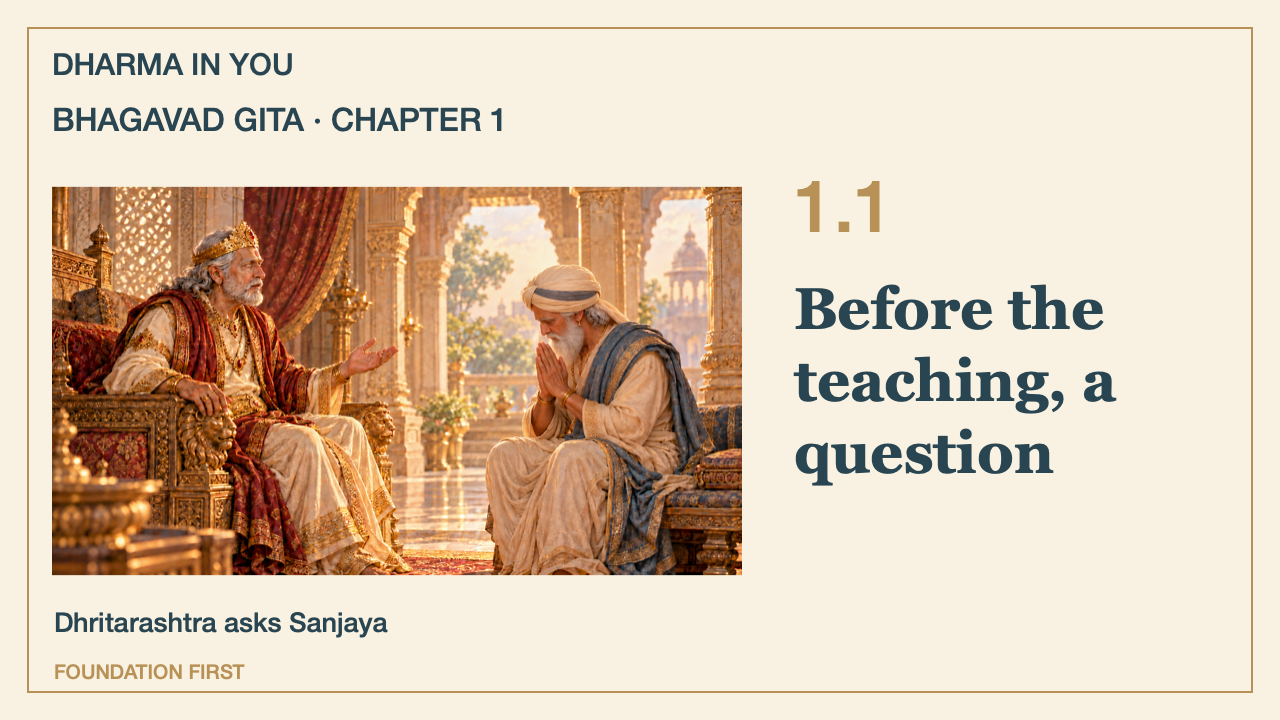
Bhagavad Gita 1.1: Before the teaching, a question

1.1 · Preview available

Before the teaching, a question

Watch preview →

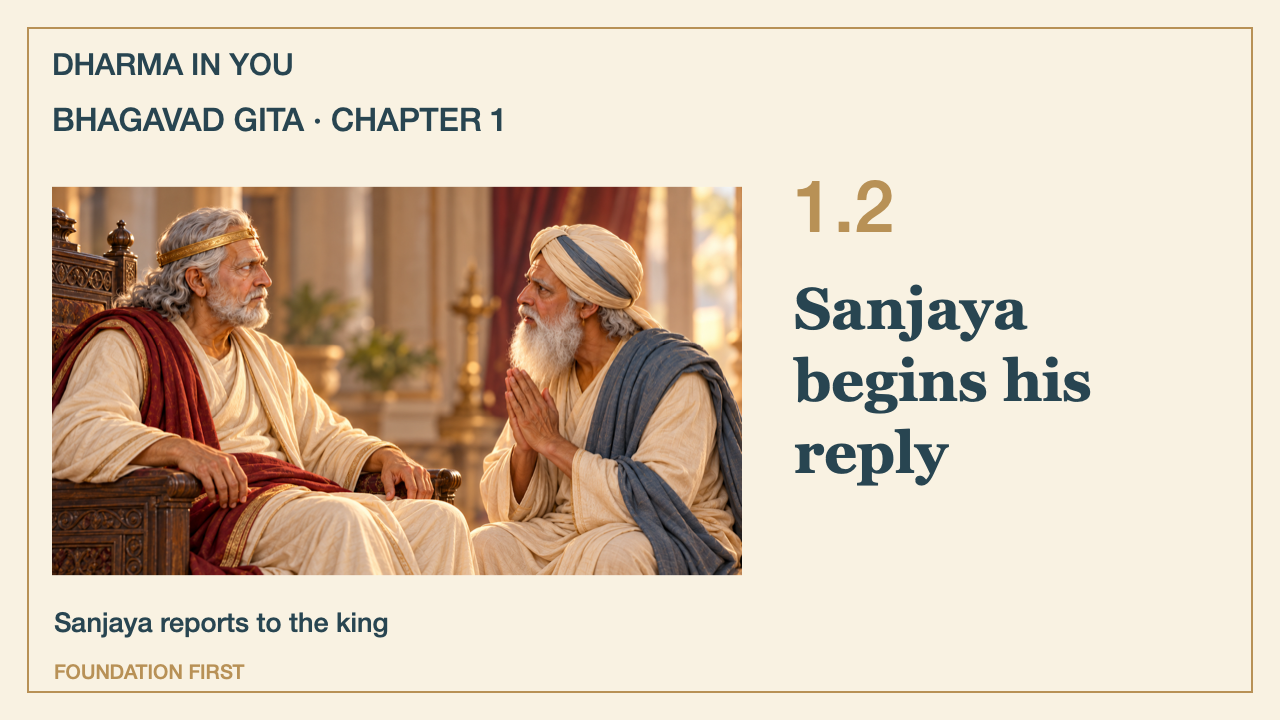
Bhagavad Gita 1.2: Sanjaya begins his reply

1.2 · Preview available

Sanjaya begins his reply

Watch preview →

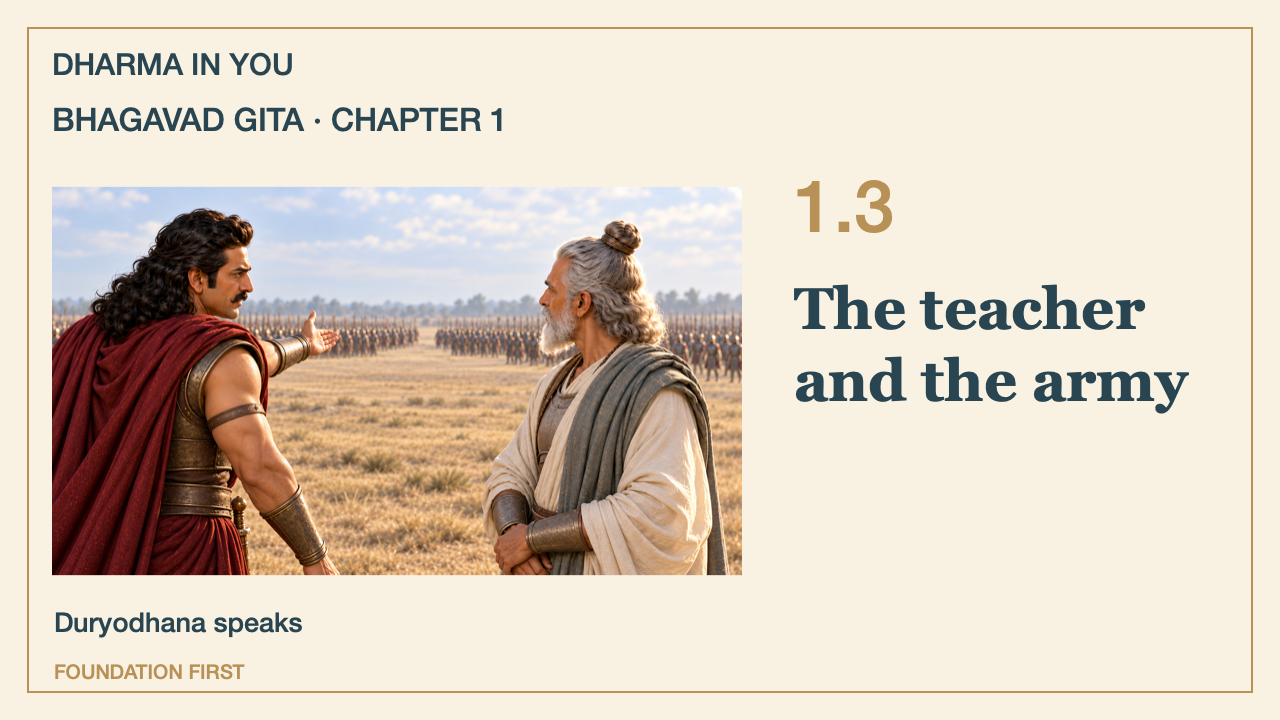
Bhagavad Gita 1.3: The teacher and the opposing army

1.3 · Preview available

The teacher and the opposing army

Watch preview →

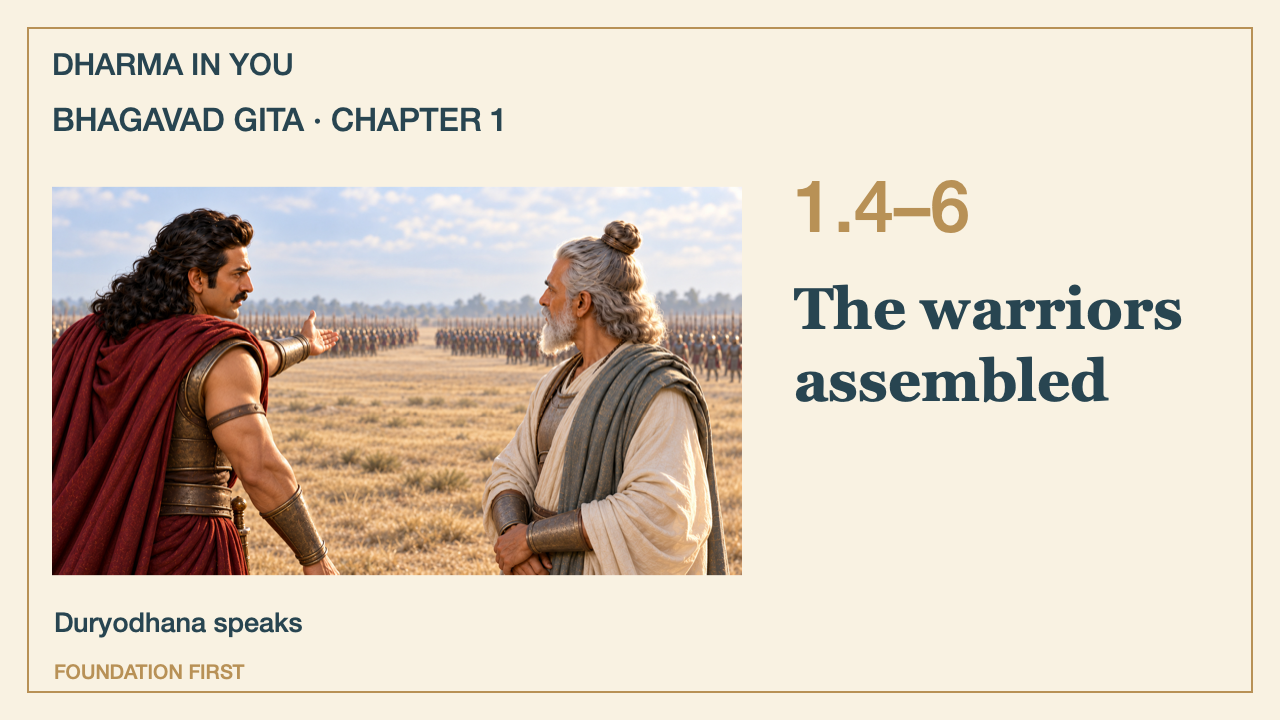
Bhagavad Gita 1.4–6: Names behind the two sides

1.4–6 · Preview available

Names behind the two sides

Watch preview →

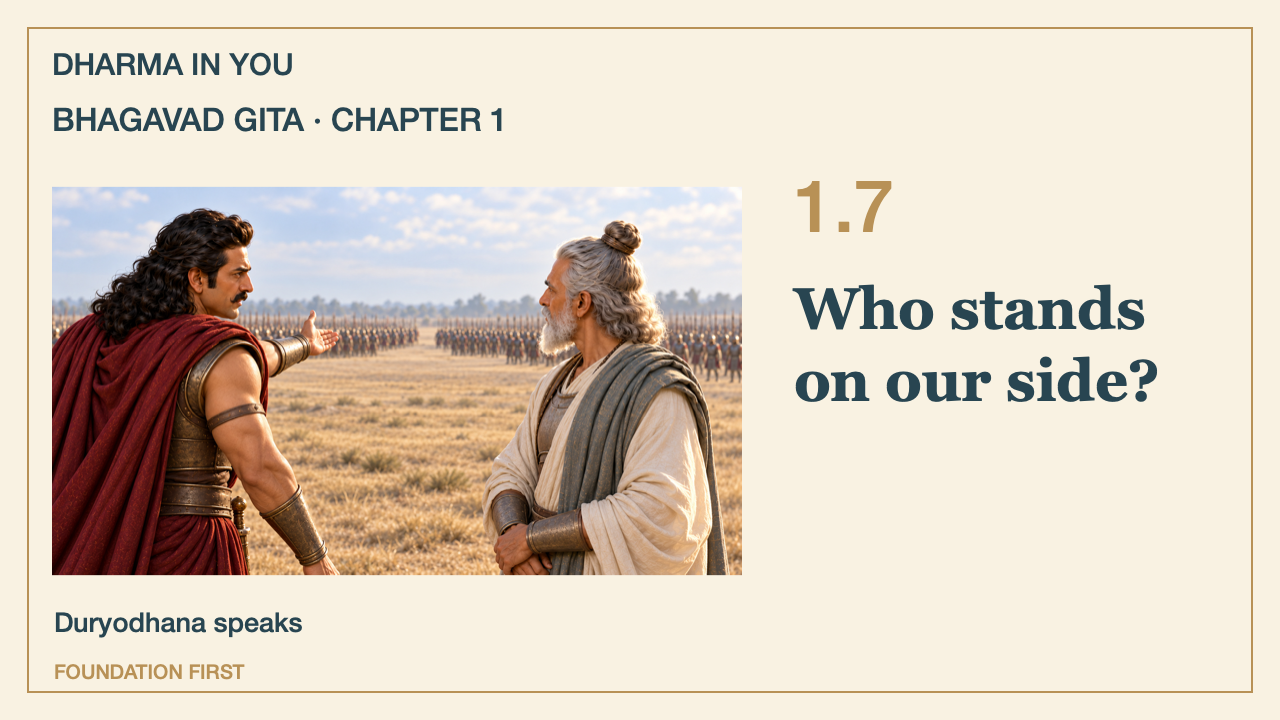
Bhagavad Gita 1.7: Attention turns to our side

1.7 · Preview available

Attention turns to our side

Watch preview →

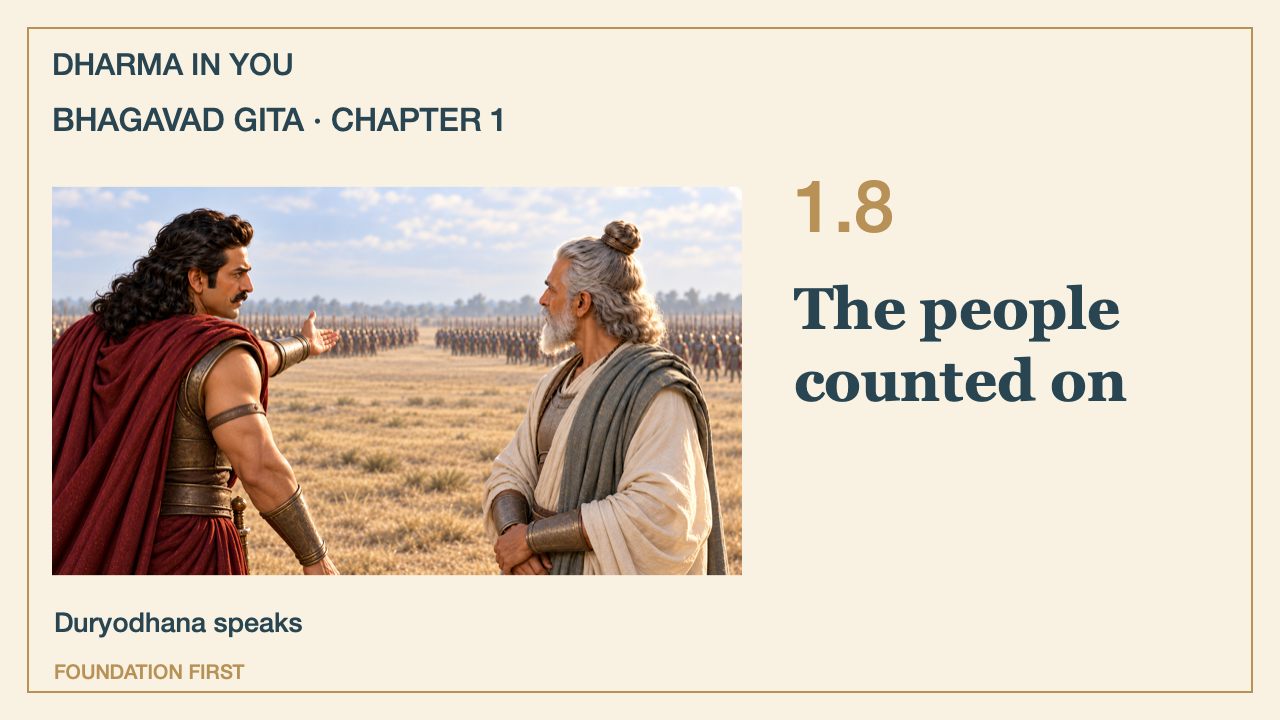
Bhagavad Gita 1.8: The people being counted on

1.8 · Preview available

The people being counted on

Watch preview →

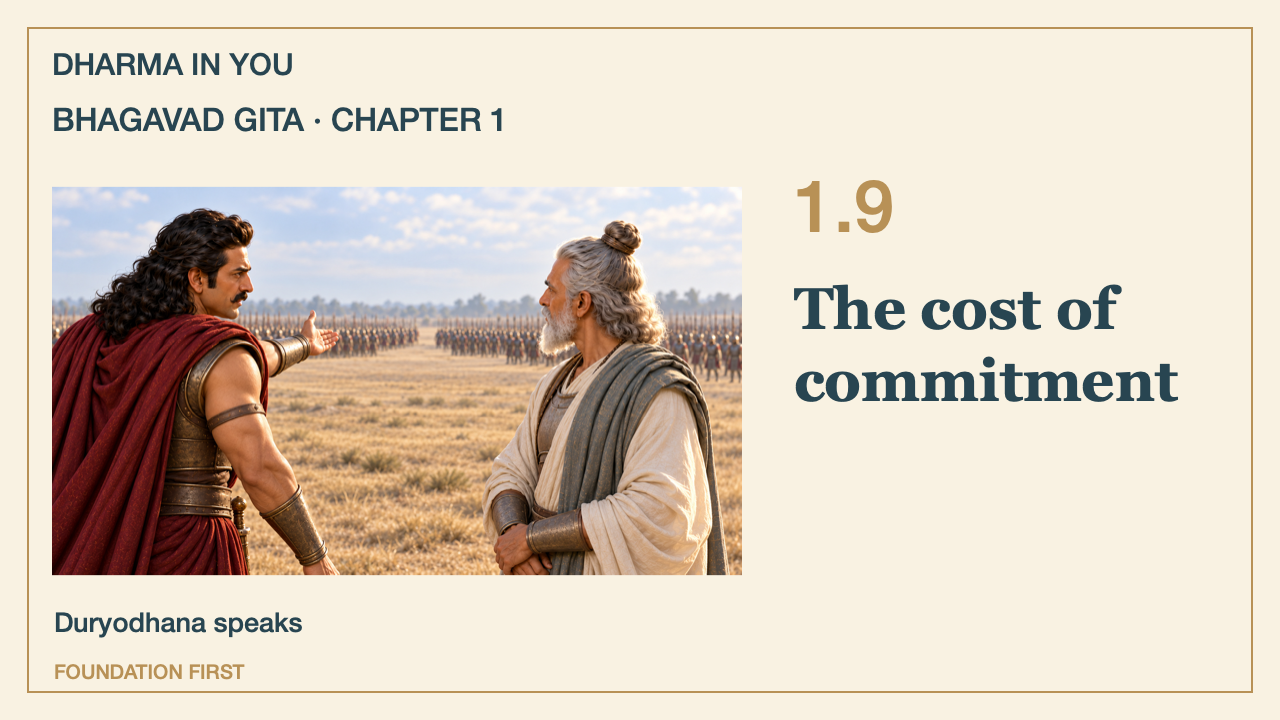
Bhagavad Gita 1.9: The cost of commitment

1.9 · Preview available

The cost of commitment

Watch preview →

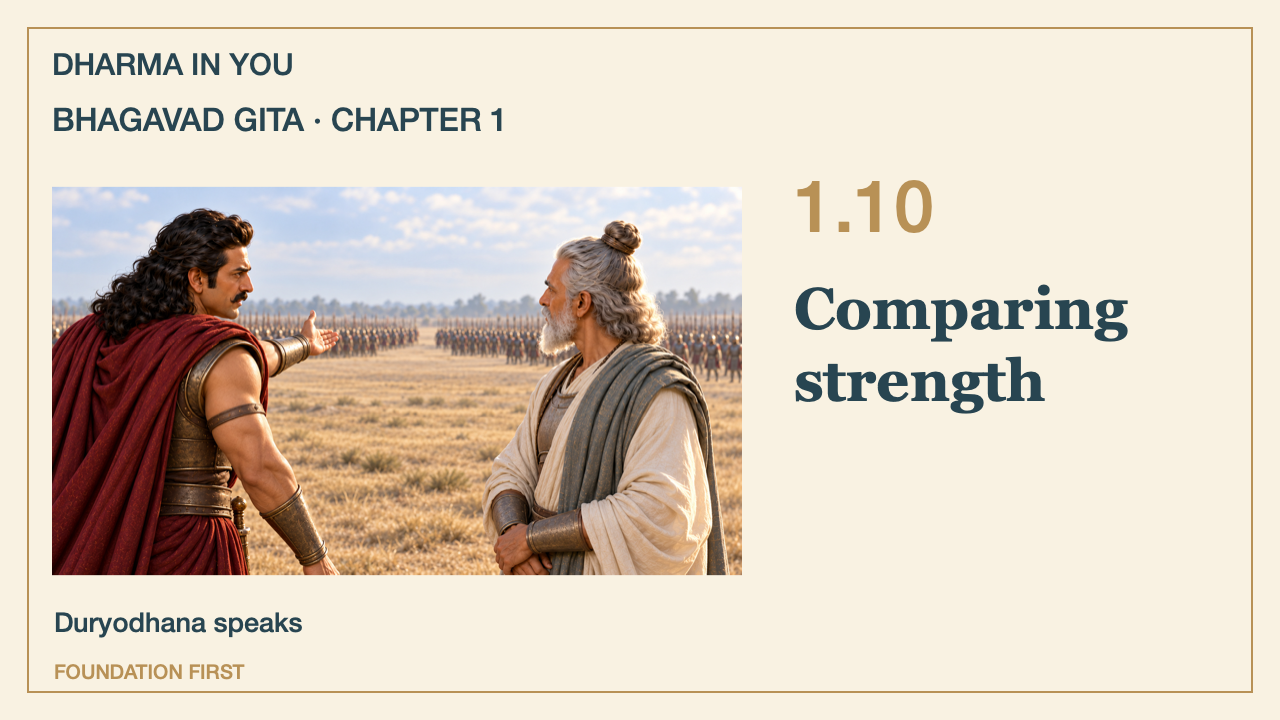
Bhagavad Gita 1.10: Comparing strength

1.10 · Preview available

Comparing strength

Watch preview →

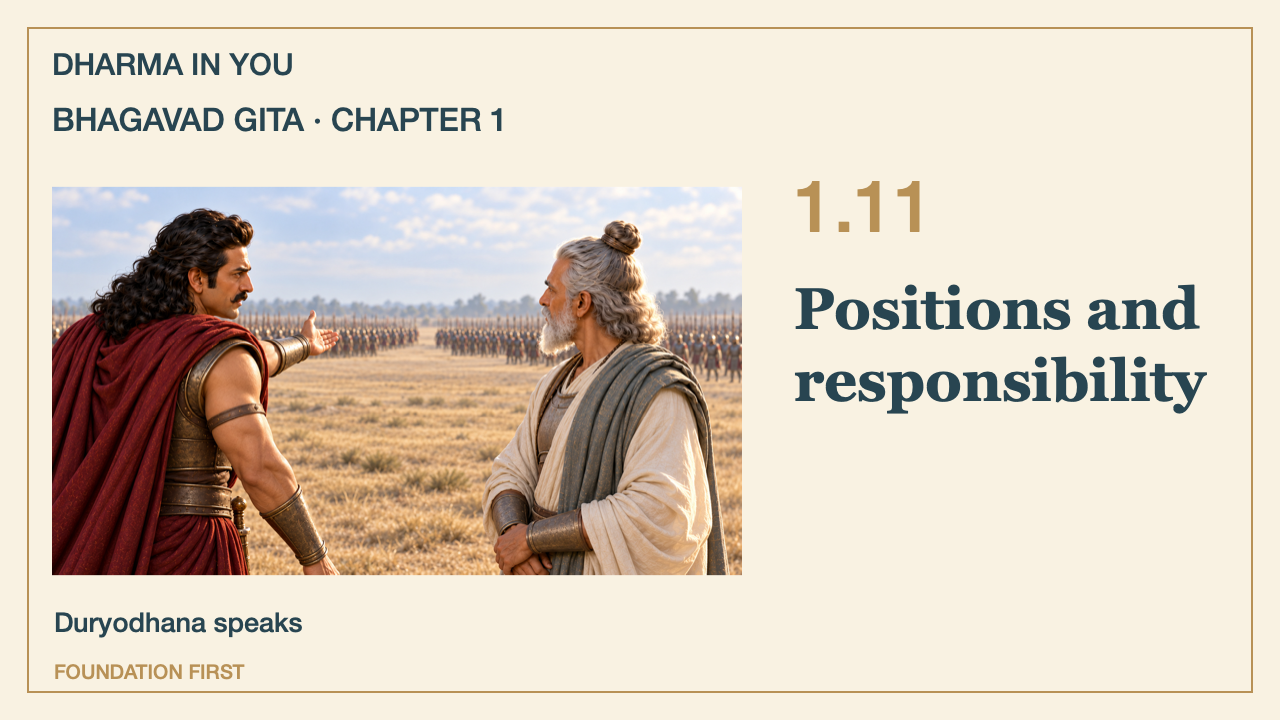
Bhagavad Gita 1.11: Positions and responsibility

1.11 · Preview available

Positions and responsibility

Watch preview →

SECTION 2 · VERSES 12–19

The conches sound

Notice the named participants and the sequence before the battle.
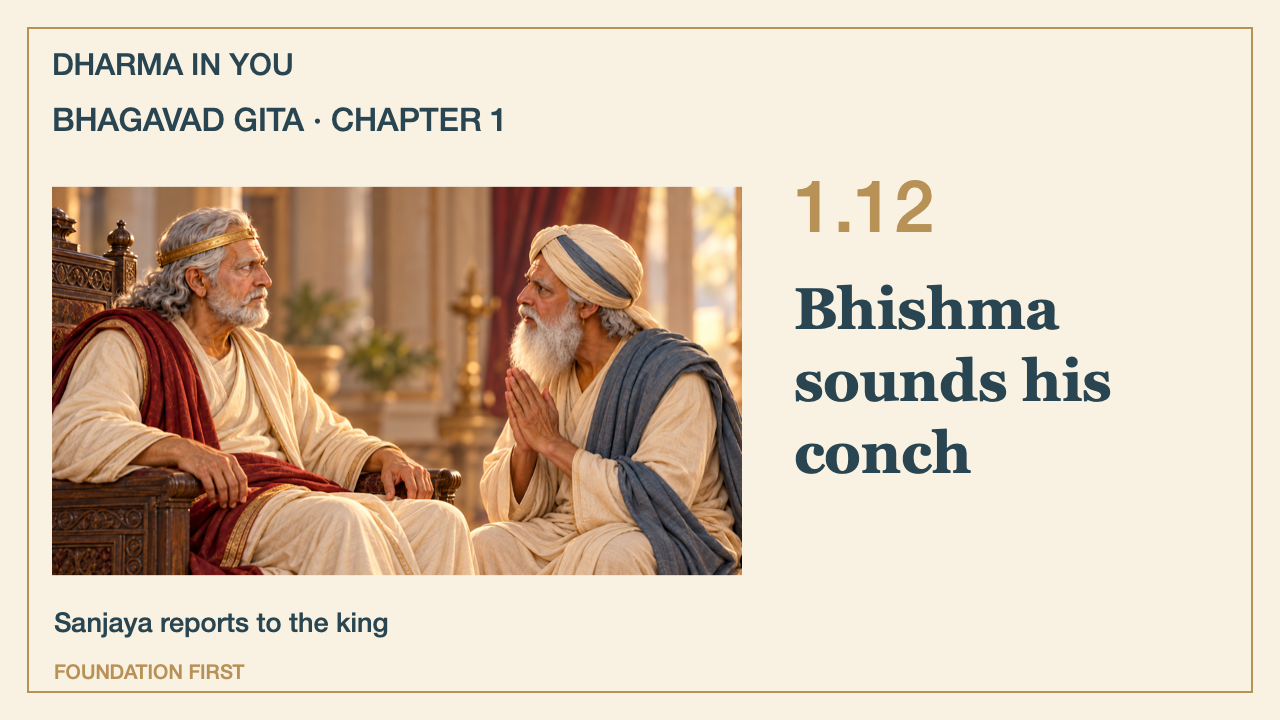
Bhagavad Gita 1.12: Bhishma sounds his conch

1.12 · Preview available

Bhishma sounds his conch

Watch preview →

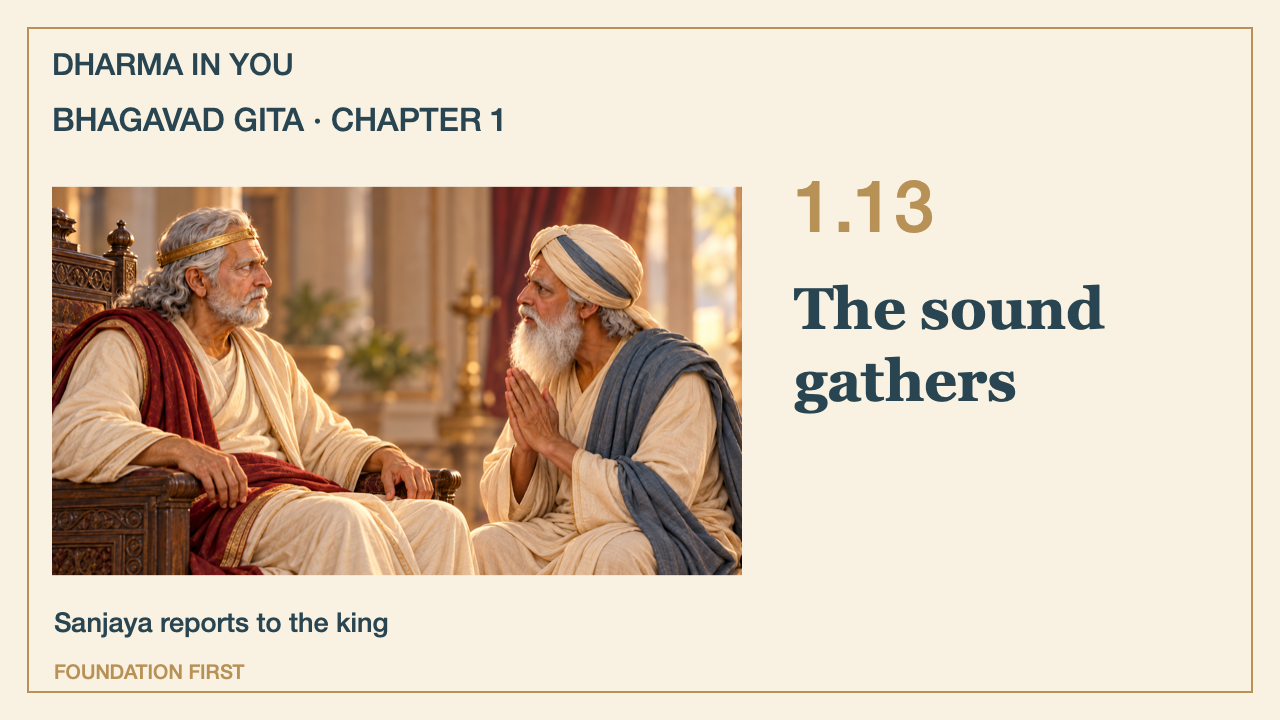
Bhagavad Gita 1.13: The sound gathers

1.13 · Video available

The sound gathers

Watch lesson →

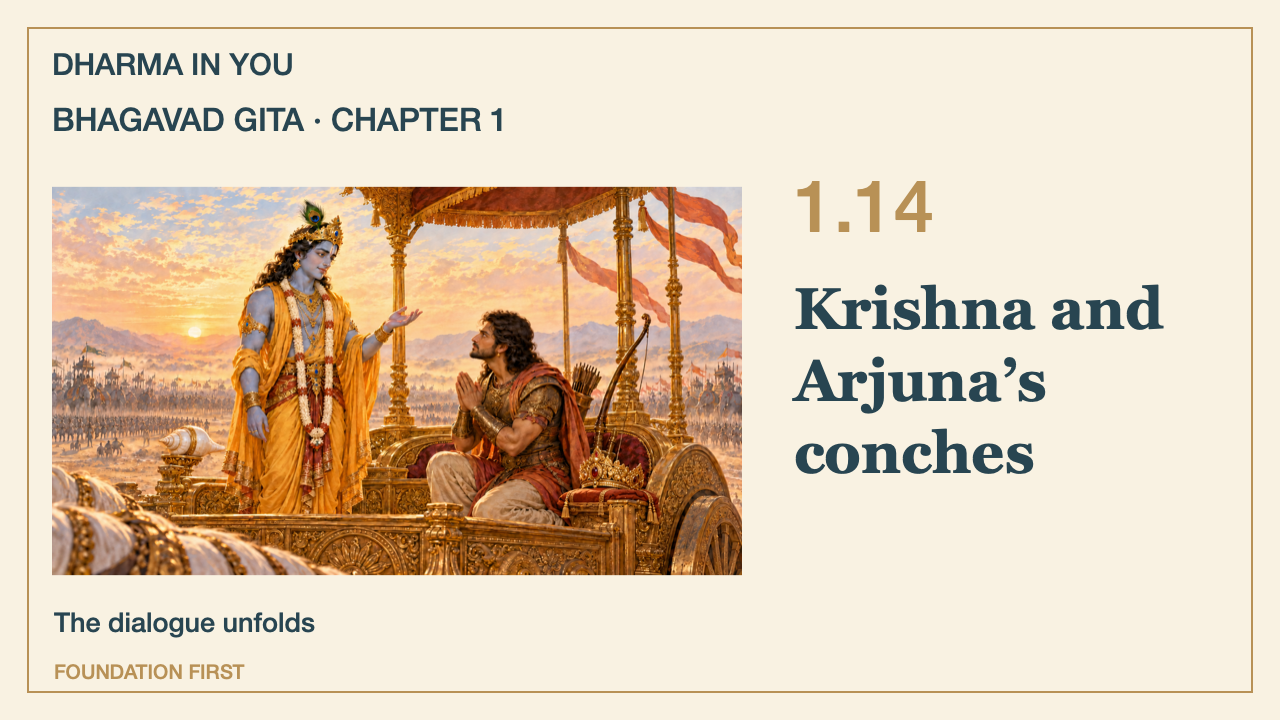
Bhagavad Gita 1.14: Krishna and Arjuna sound their conches

1.14 · Video available

Krishna and Arjuna sound their conches

Watch lesson →

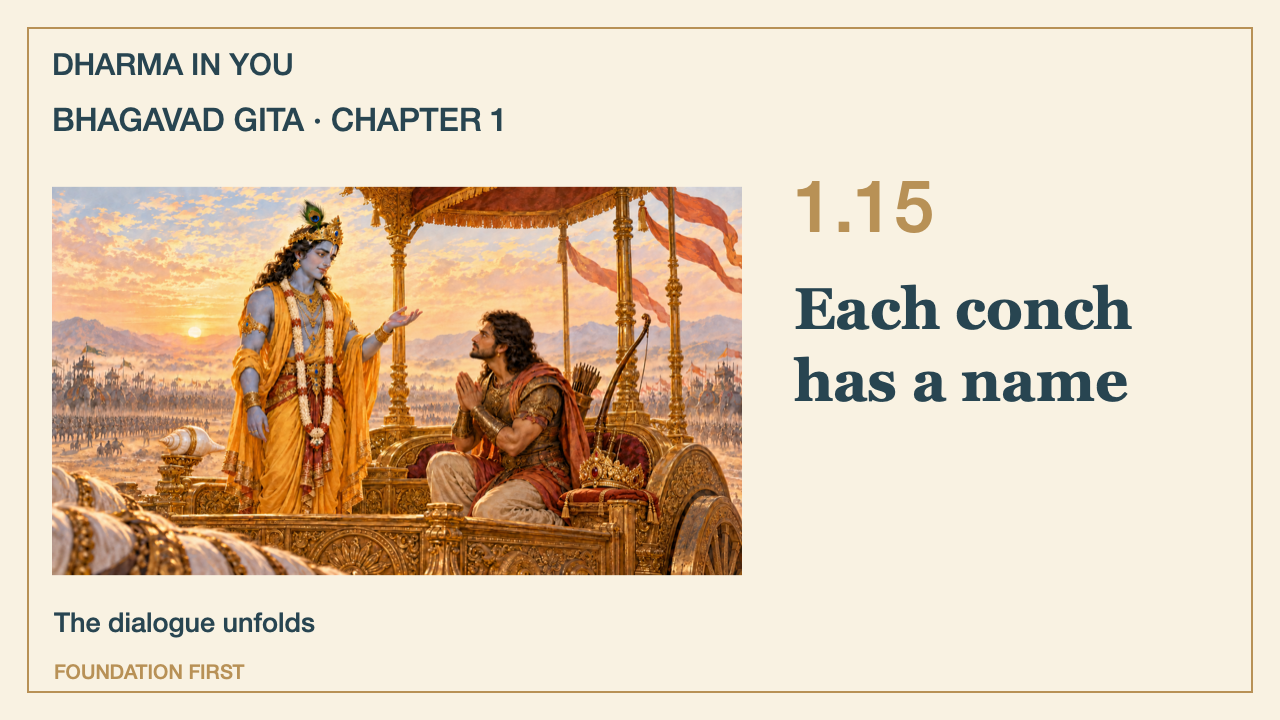
Bhagavad Gita 1.15: Each conch has a name

1.15 · Video available

Each conch has a name

Watch lesson →

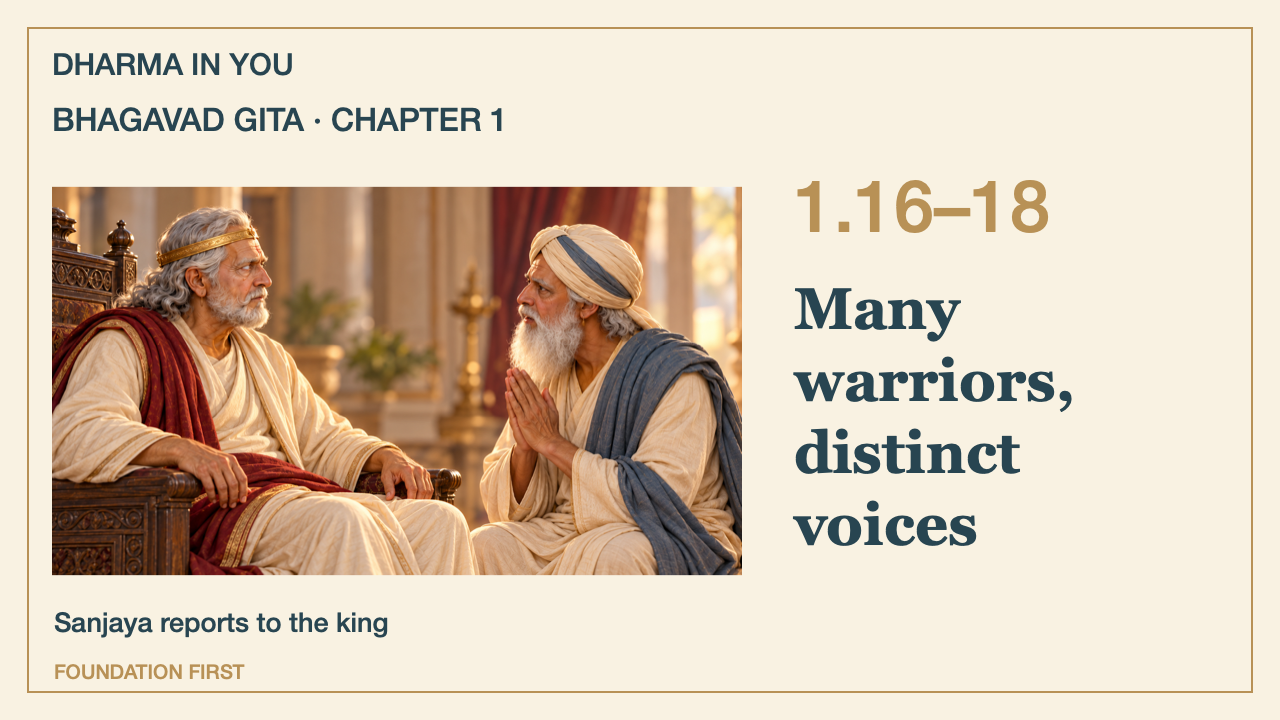
Bhagavad Gita 1.16–18: Many warriors, distinct voices

1.16–18 · Video available

Many warriors, distinct voices
Watch lesson →

Bhagavad Gita 1.19: The sound and its effect

1.19 · Video available

The sound and its effect

Watch lesson →

SECTION 3 · VERSES 20–27

Between the two armies

Follow Arjuna’s request and the people he sees before him.
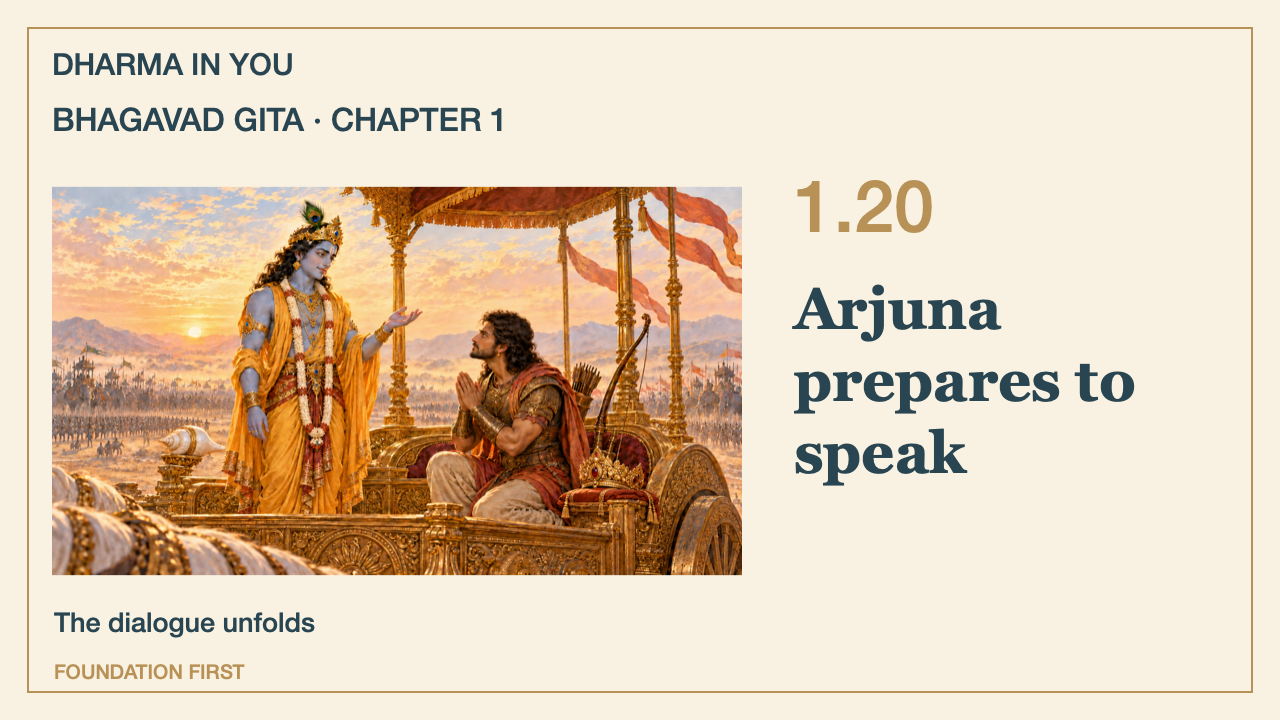
Bhagavad Gita 1.20: Arjuna prepares to speak

1.20 · Video available

Arjuna prepares to speak

Watch lesson →

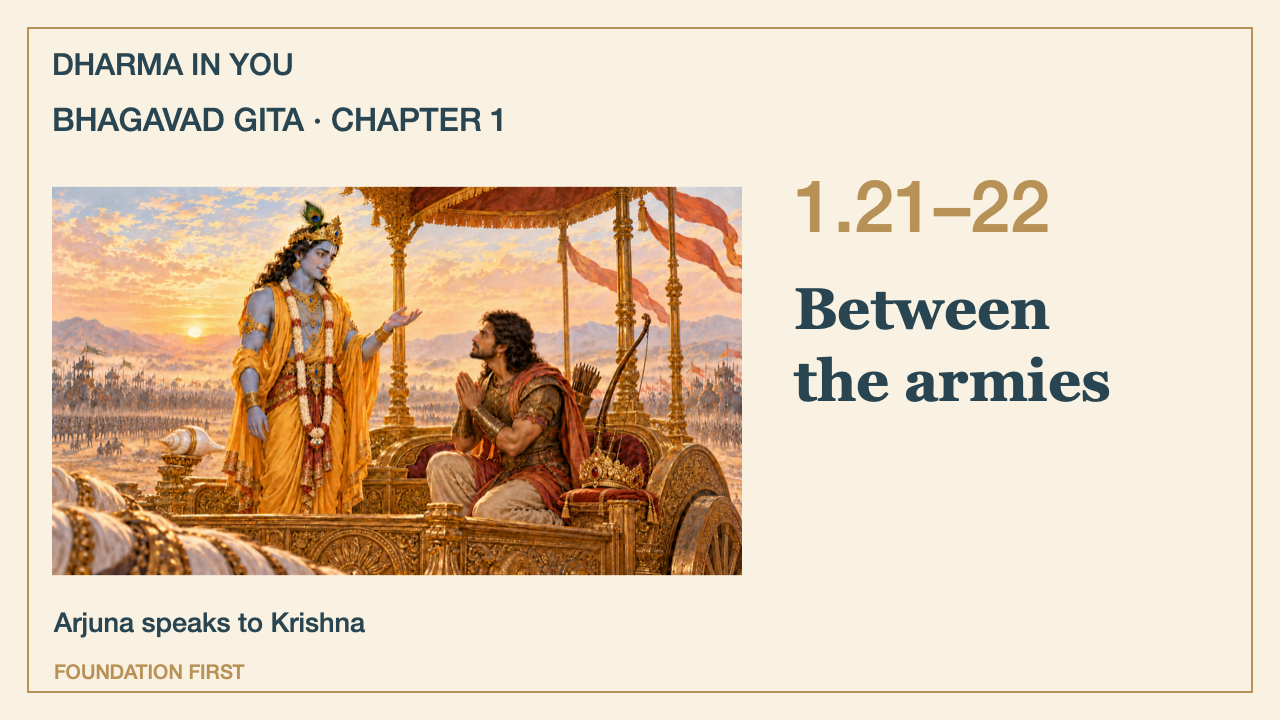
Bhagavad Gita 1.21–22: Place my chariot between the armies

1.21–22 · Video available

Place my chariot between the armies

Watch lesson →

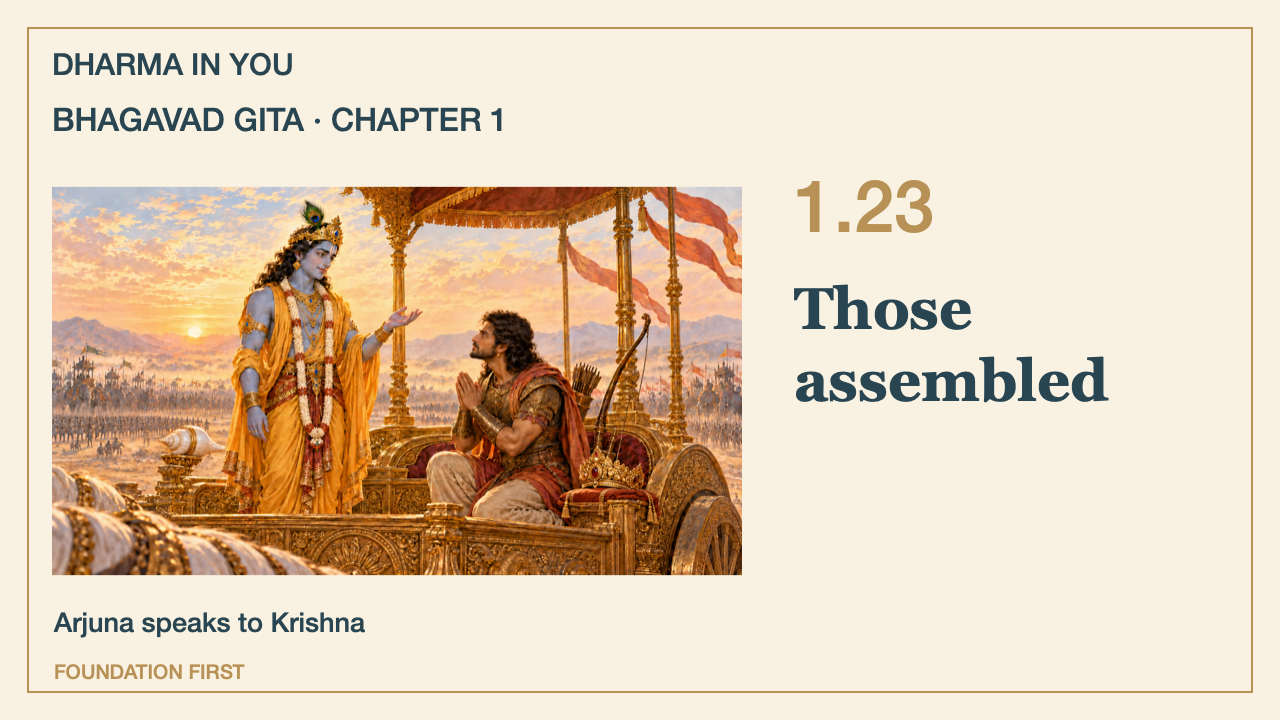
Bhagavad Gita 1.23: Arjuna looks at those assembled

1.23 · Video available

Arjuna looks at those assembled

Watch lesson →

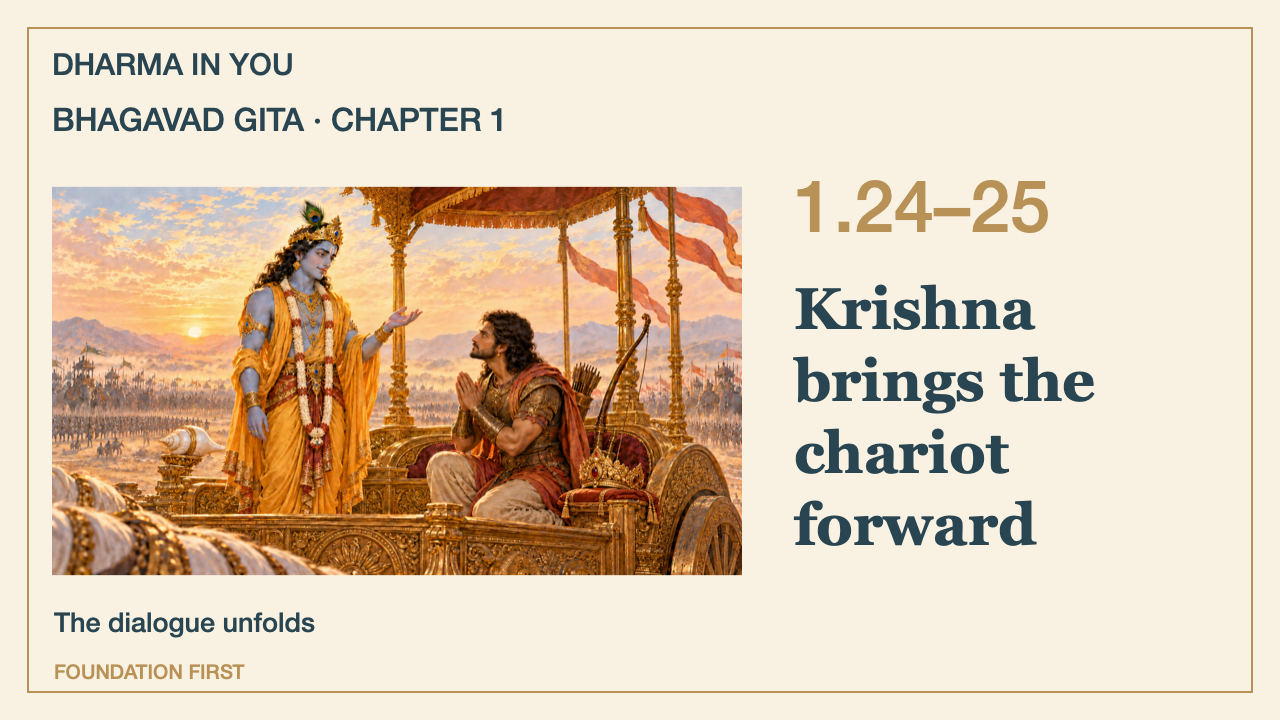
Bhagavad Gita 1.24–25: Krishna brings the chariot forward

1.24–25 · Video available

Krishna brings the chariot forward

Watch lesson →

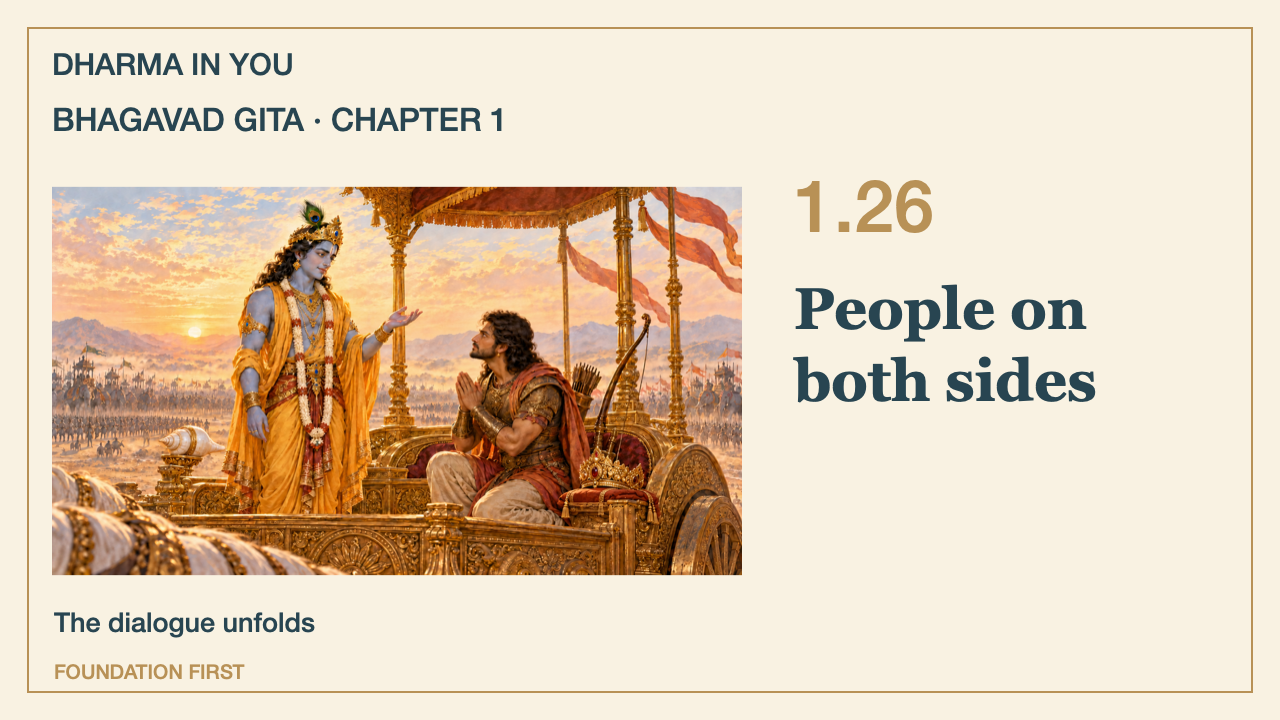
Bhagavad Gita 1.26: People on both sides

1.26 · Video available

People on both sides

Watch lesson →

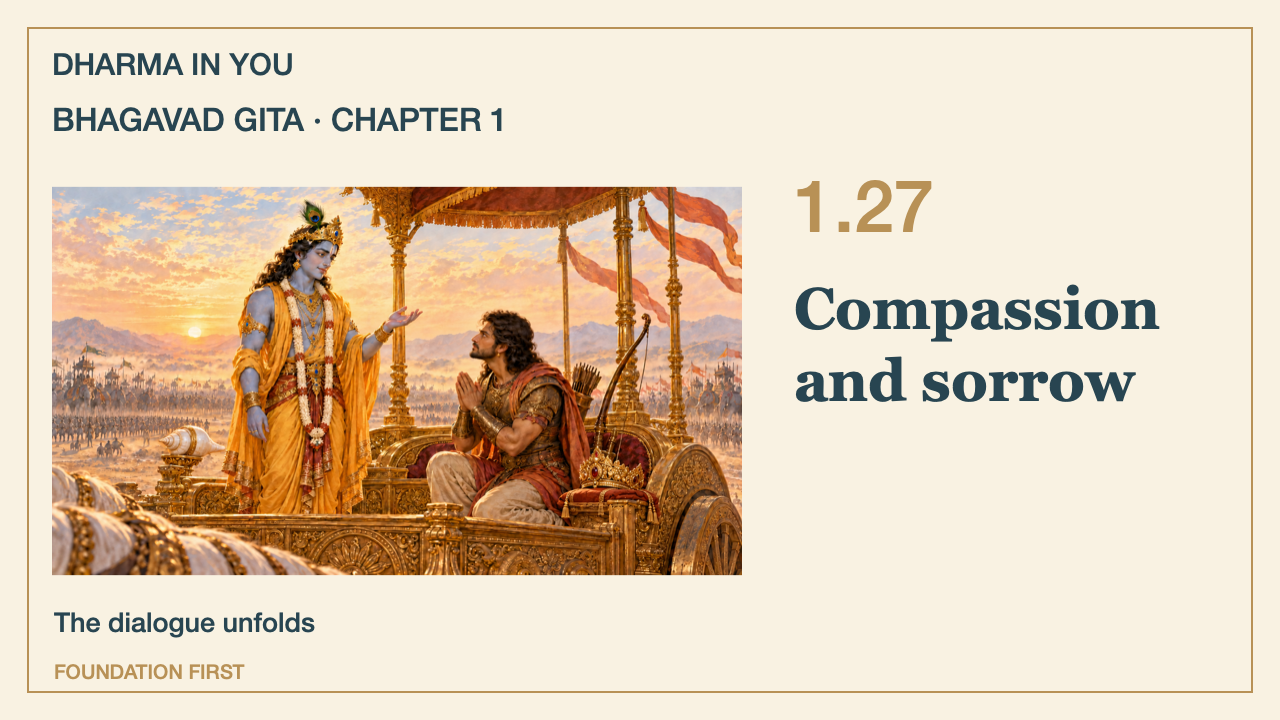
Bhagavad Gita 1.27: Compassion and sorrow arise

1.27 · Video available

Compassion and sorrow arise

Watch lesson →

SECTION 4 · VERSES 28–35

Distress and the meaning of victory

Listen to Arjuna describe his distress and question what victory would mean.
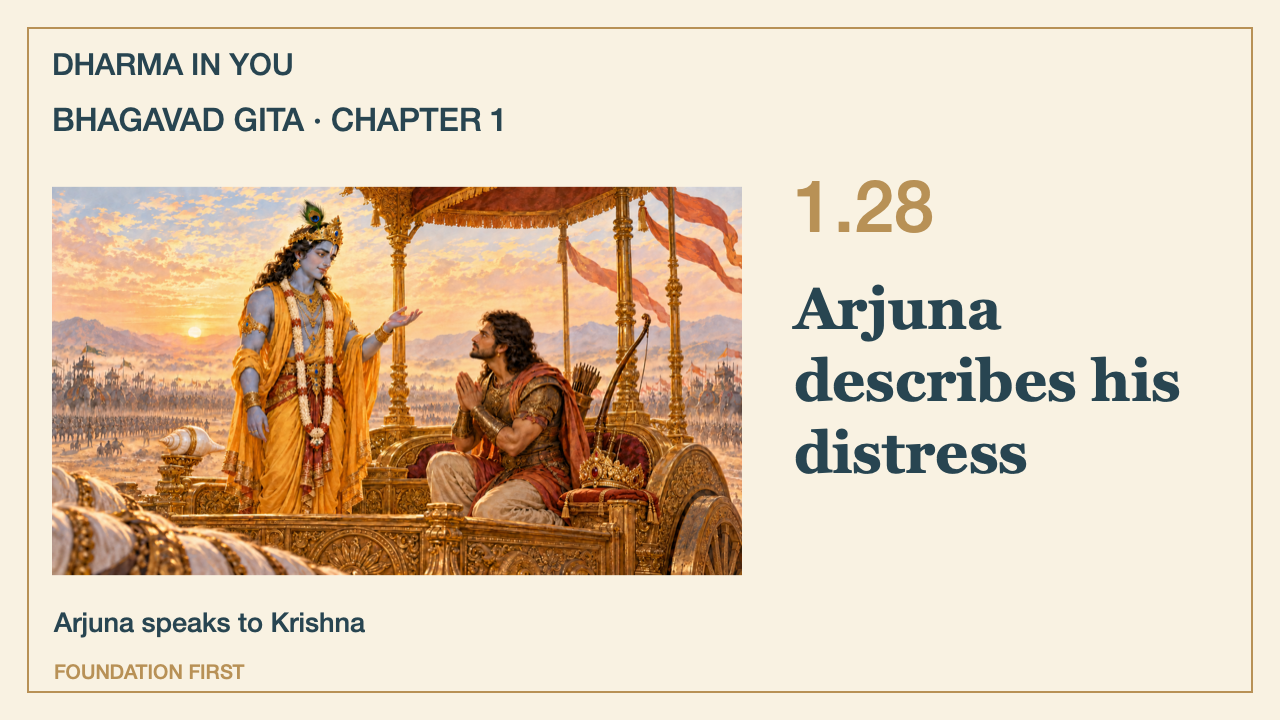
Bhagavad Gita 1.28: Arjuna describes his distress

1.28 · Video available

Arjuna describes his distress

Watch lesson →

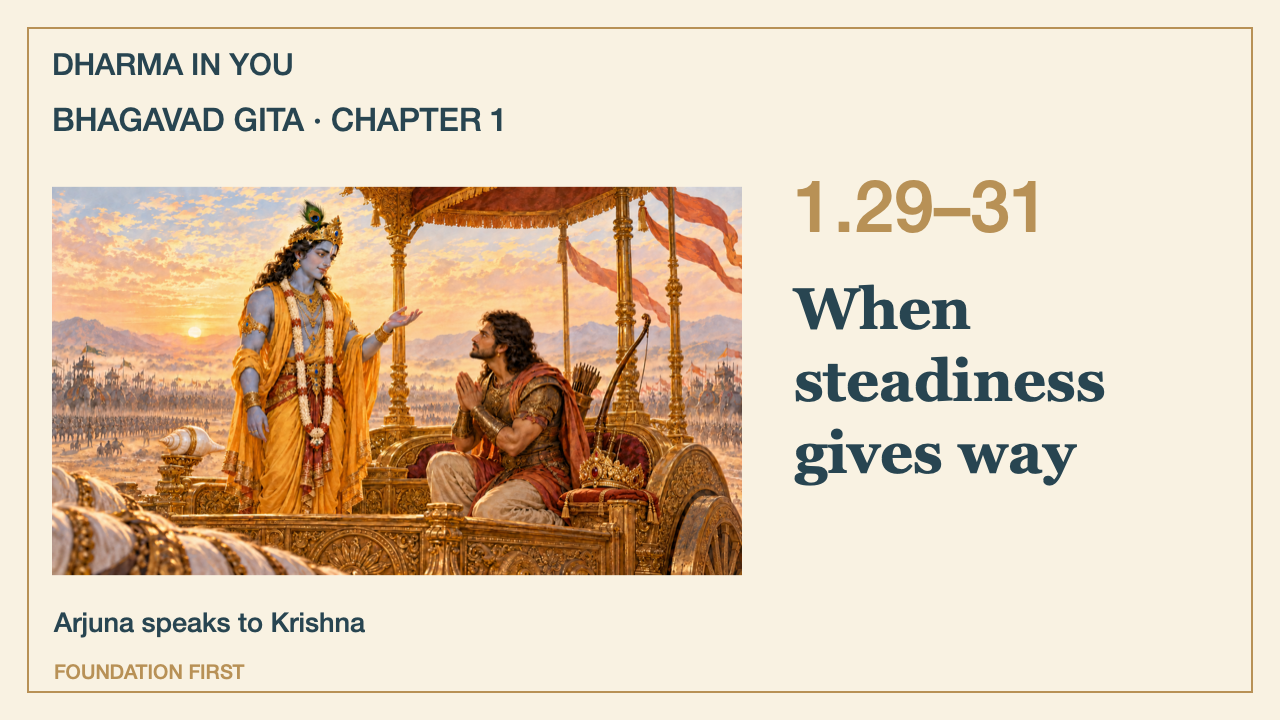
Bhagavad Gita 1.29–31: When steadiness gives way

1.29–31 · Video available

When steadiness gives way

Watch lesson →

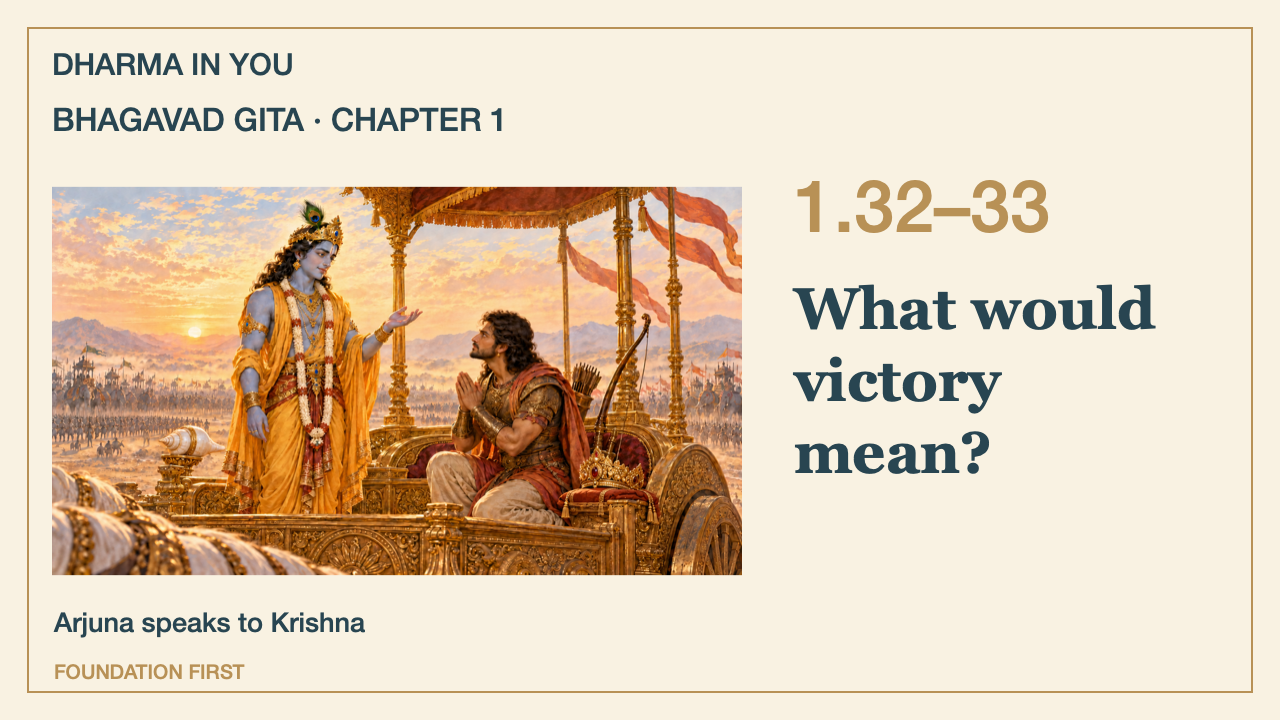
Bhagavad Gita 1.32–33: What would victory mean?

1.32–33 · Video available

What would victory mean?

Watch lesson →

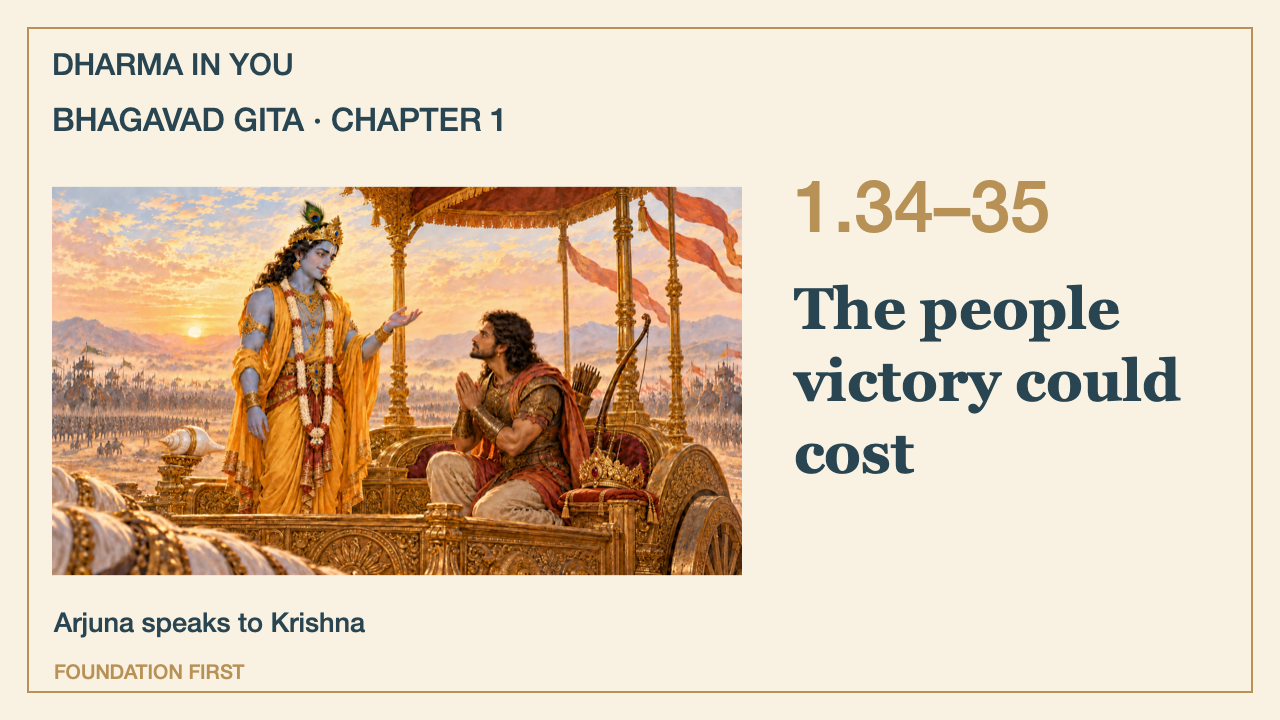
Bhagavad Gita 1.34–35: The people victory could cost

1.34–35 · Video available

The people victory could cost

Watch lesson →

SECTION 5 · VERSES 36–46

Family, duty and consequences

Read Arjuna’s concerns in context, as his words at this point in the dialogue.
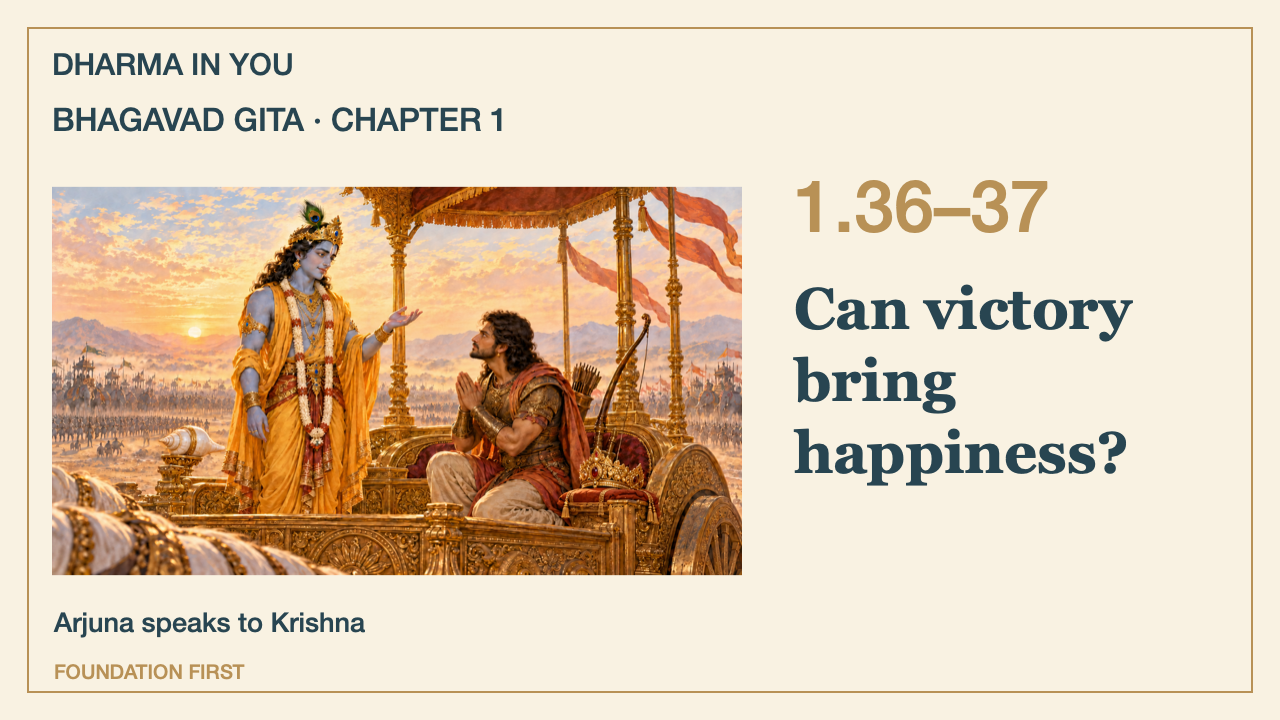
Bhagavad Gita 1.36–37: Can victory bring happiness?

1.36–37 · Video available

Can victory bring happiness?

Watch lesson →

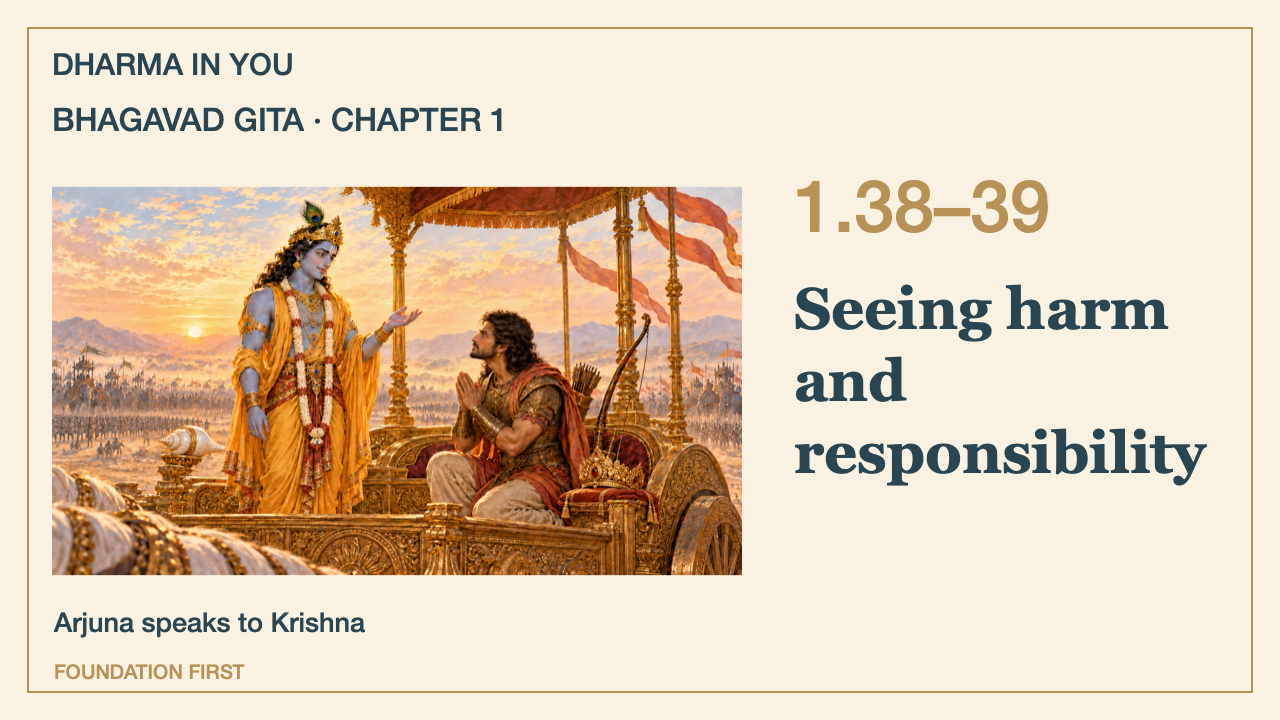
Bhagavad Gita 1.38–39: Seeing harm and taking responsibility

1.38–39 · Video available

Seeing harm and taking responsibility

Watch lesson →

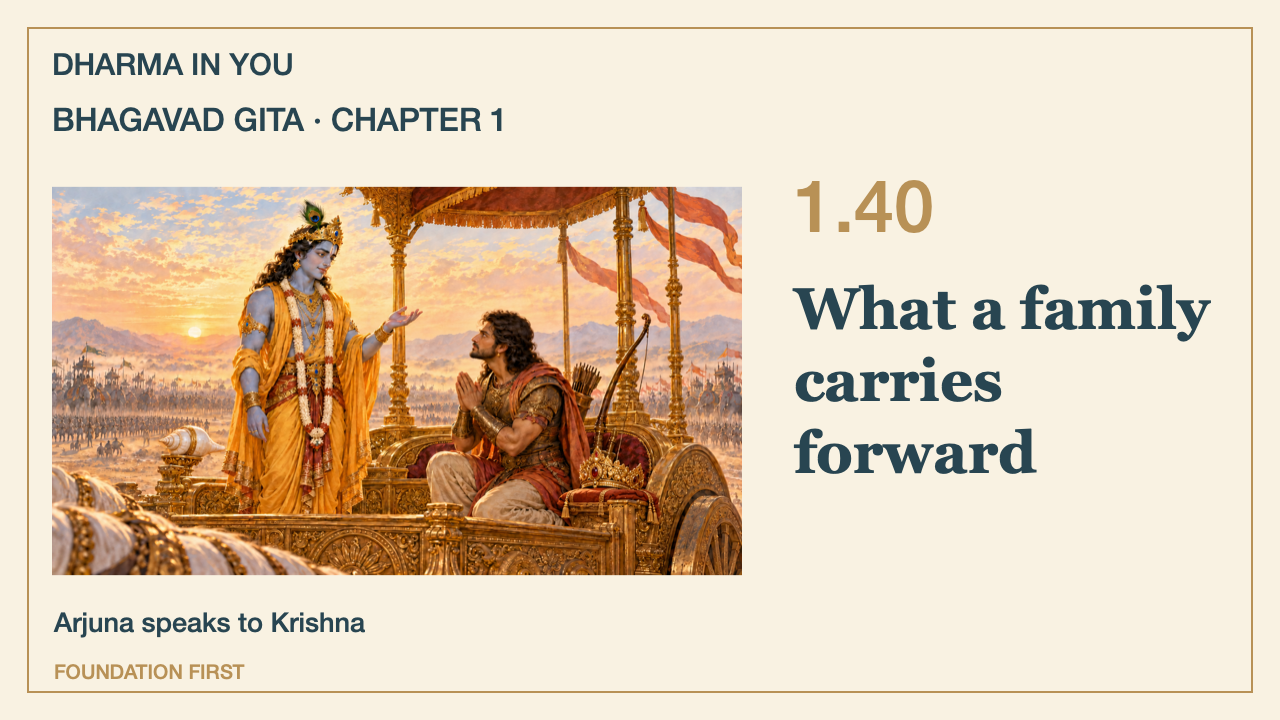
Bhagavad Gita 1.40: What a family carries forward

1.40 · Video available

What a family carries forward

Watch lesson →

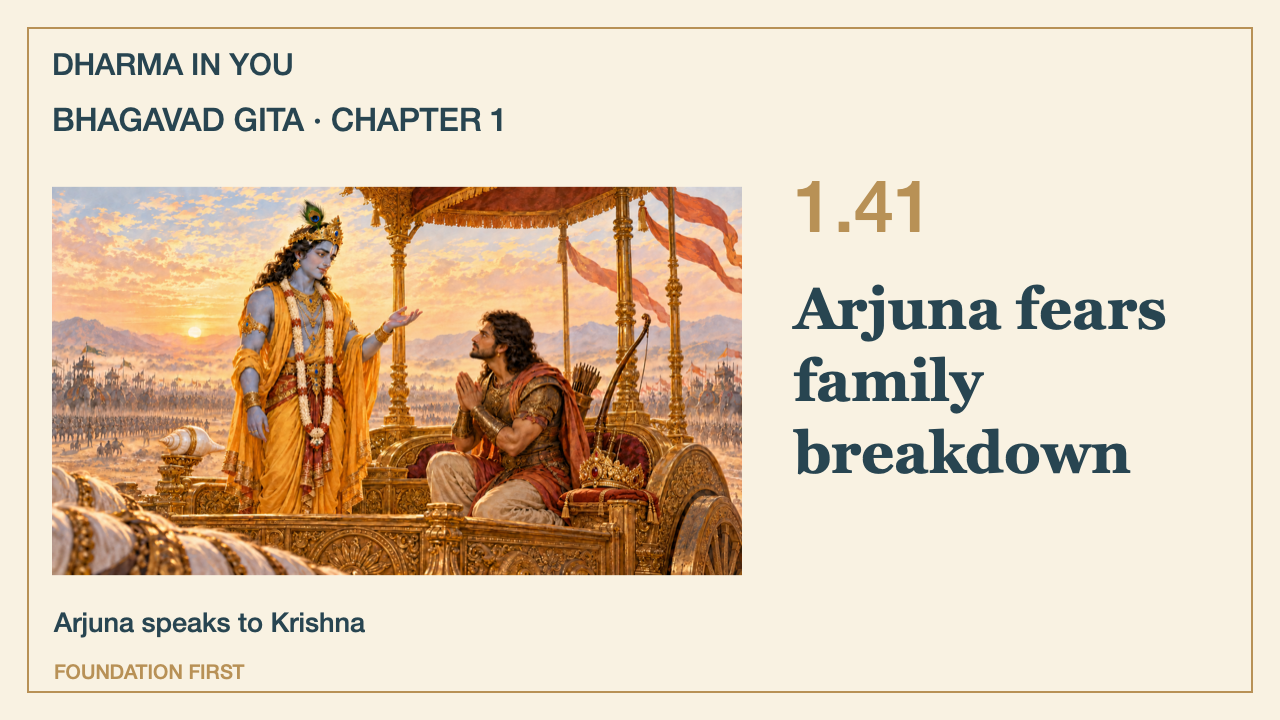
Bhagavad Gita 1.41: Arjuna fears a breakdown of family order

1.41 · Video available

Arjuna fears a breakdown of family order

Watch lesson →

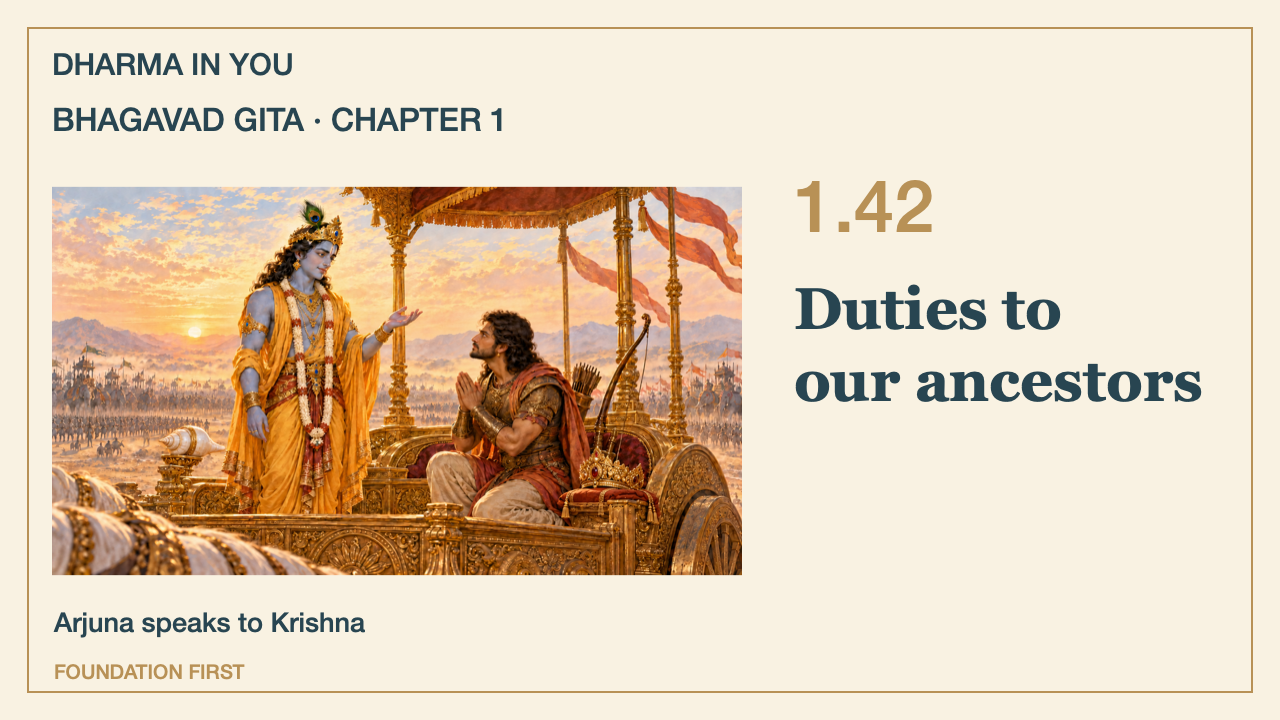
Bhagavad Gita 1.42: Remembering duties to ancestors

1.42 · Video available

Remembering duties to ancestors

Watch lesson →

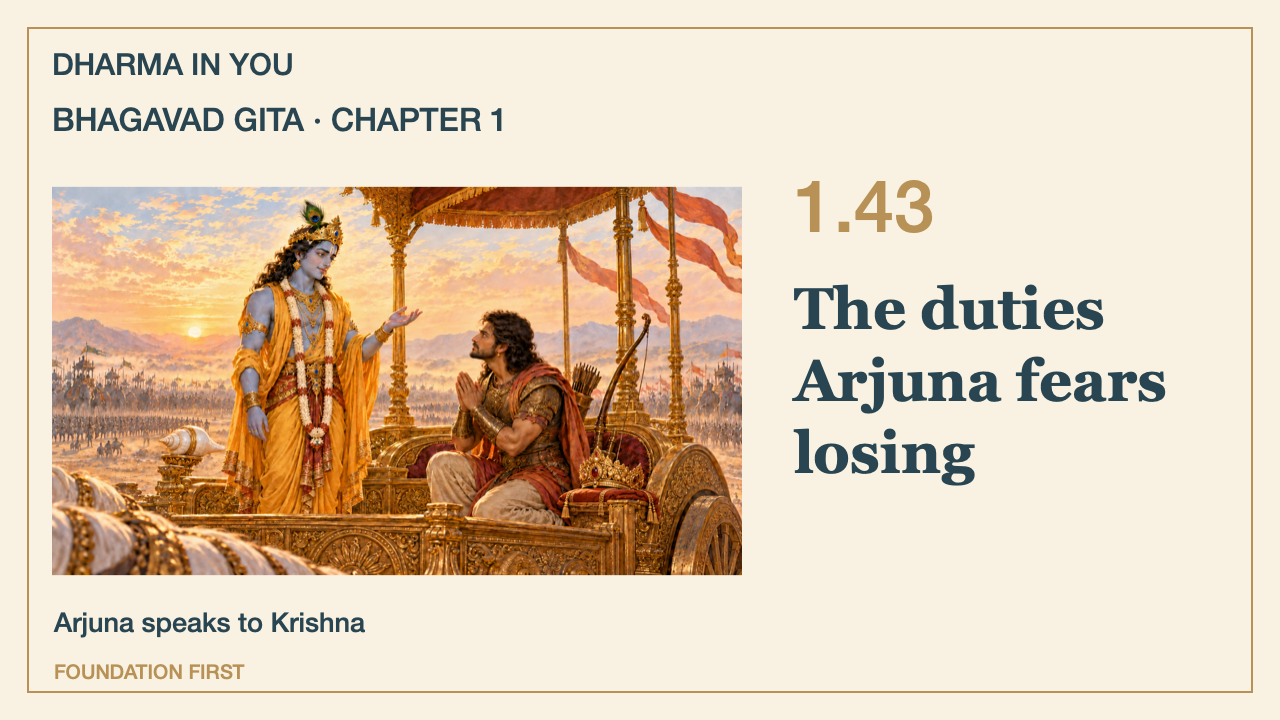
Bhagavad Gita 1.43: The duties Arjuna fears losing

1.43 · Video available

The duties Arjuna fears losing

Watch lesson →

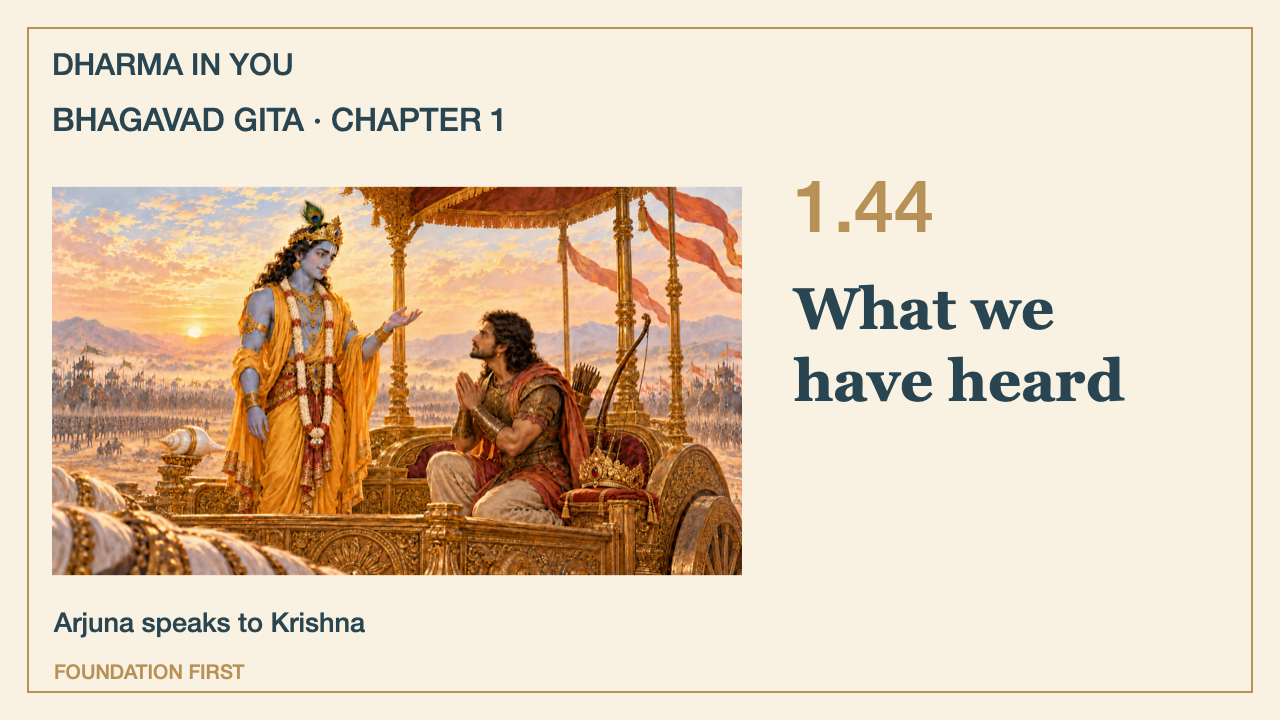
Bhagavad Gita 1.44: What we have heard

1.44 · Video available

What we have heard

Watch lesson →

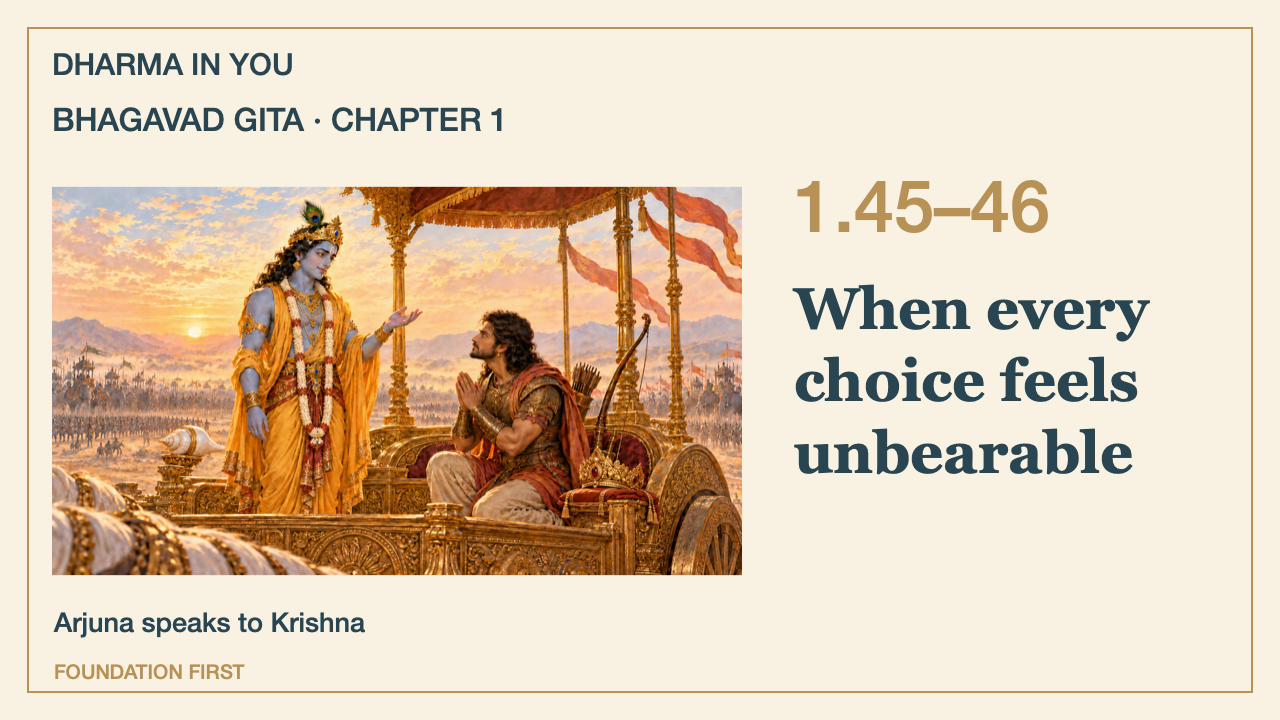
Bhagavad Gita 1.45–46: When every choice feels unbearable

1.45–46 · Video available

When every choice feels unbearable

Watch lesson →

SECTION 6 · VERSES 47

The bow is set aside

Pause with the unresolved crisis before moving into Chapter 2.
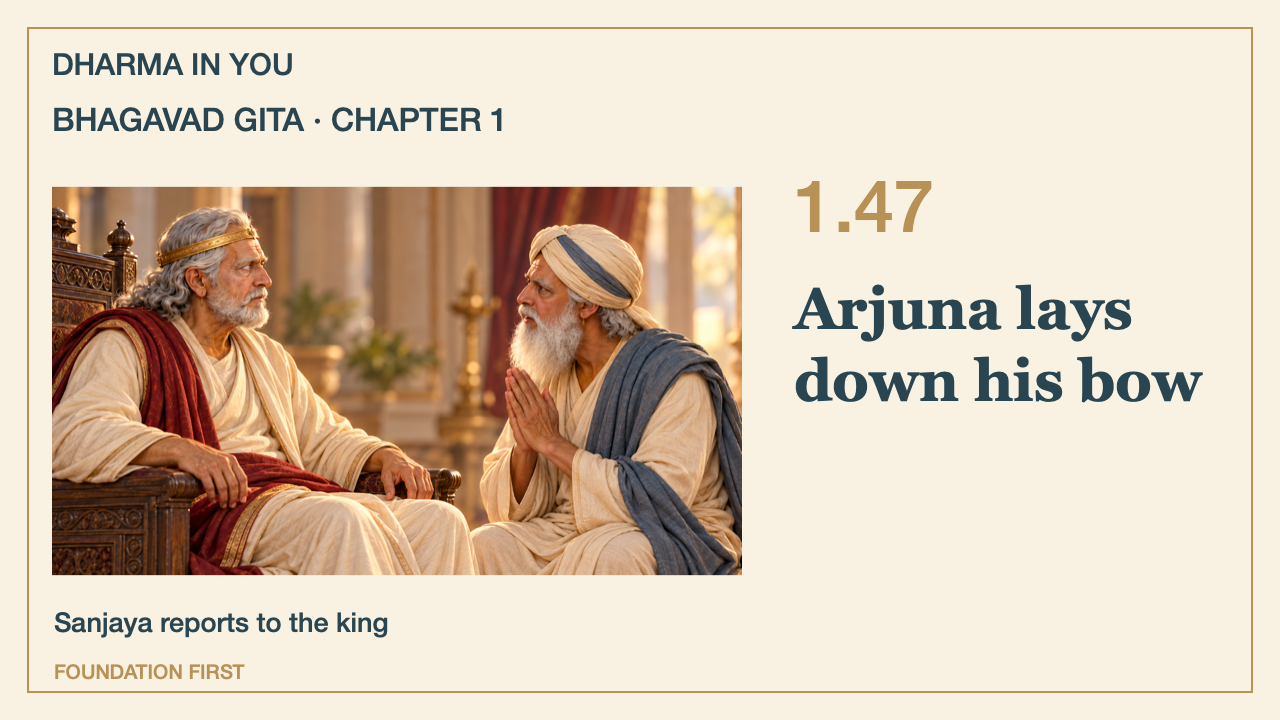
Bhagavad Gita 1.47: Arjuna lays down his bow

1.47 · Video available

Arjuna lays down his bow

Watch lesson →

When you finish Chapter 1

Before continuing, recall the situation in your own words. Who asks the opening question? Why does Arjuna ask to see those assembled? What concerns does he express?

For your own reflection: when a decision feels overwhelming, what do you know, what are you assuming, and where could patient guidance help?

Explore Chapter 2 — Sāṅkhya Yoga

Chapter 2 is available: follow all 26 teaching films covering its 72 verses in order, or choose a lesson.